Wednesday, 21 September 2022

#bookreview: Invisible boy: A Memoir of Self-Discovery | Harrison Mooney

Invisible Boy: A Memoir of Self-DiscoveryInvisible Boy: A Memoir of Self-Discovery by Harrison Mooney
My rating: 5 of 5 stars

Reading Invisible Boy is like refreshing my memory about the weird pentecostal days I grew up in, even though I'm on a whole different continent with vastly different racial and religious tensions.

The book is Mooney's memoir about growing up black in white fundamentalist Christian churches & schools in Canada, but many of the same pervasive and, honestly, skewed messages that festered in white North American churches in the 90s also made its way over to Malaysia. The roots of what I've seen and experienced as echoes all the way over here are exposed in full technicolour in Mooney's experiences. It doesn't help that Malaysia still, on the whole, idealises and idolises whiteness and white proximity; and that Chinese Malaysians are often just as racist, especially with respect to Indians.

Mooney says in his author's note:
I acknowledge here that what is said is not the same as what is meant. It doesn't matter anyhow. Intent is not impact, and if we continue to prioritize the goodness of our thoughts above the violence of our actions, we will leave a trail of victims in our wake. Mine is a story of impact; I write for the millions impacted in similar ways.
I have seen this reflected elsewhere as well, with an acquaintance emphasising that when engaging, impact should be considered before intent. We live in tumultuous times and I think it's worth the wake up call for those who profess to be Christians to consider the unintentional harm the church has caused many communities in the name of Christ, even if the intentions were good.

After all, the road to hell is paved with good intentions.

Note: I received a digital ARC of this book from Steerforth Press via Edelweiss. Opinions expressed in this review are completely my own.

View all my reviews

Wednesday, 7 September 2022

#NetGalley #bookreview: Silver Under Nightfall | Rin Chupeco

Silver Under NightfallSilver Under Nightfall by Rin Chupeco


Okay, I'll mark this one down to "not knowing what I was getting into". I basically went, "vampires, meh; but Rin Chupeco, ok lah, why not?"

Um so, probably disclaimers upfront because, uhhhhh. There are a lot of sexy times in this book (and not the fade-to-black kind), so if that is not for you, this book is not for you. Like really, really not.

Anyways!

Remy Pendergast is your typical pitiful downtrodden outcast who is discriminated against because of his parentage - his foreign mother is rumoured to be a vampire, or at the least, a vampire's familiar - but is very good at what he does. Which is being a Reaper, aka vampire hunter. But Lord High Steward Astonbury, leader of the dræfendgemot, is his father's bitter rival and sees to it that Remy gets none of the credit or any acknowledgement, despite him taking up the bounties every other Reaper passes on. Remy's one mission in life, as dictated by his father, is to hunt down the Night Court - the very vampire court that took his mother's life.

Enter sweet Lady Song Xiaodan, heiress of the Fourth Court and dashingly brooding Lord Zidan Malekh, King of the Third Court and you get this hilarious Regency-type romp of this royal vampire couple pursuing a blushing, self-deprecating human who believes that no one could ever love him. (Honest, this is a big chunk of what the book is about.)

Back to the plot, Xiaodan and Zidan want to establish an alliance with the humans - an unheard-of proposal in Aluria, and one that is met with much suspicion and scepticism. There's also rumour of a new mutated kind of vampire, one that turns mindless and can keep respawning bigger and stronger than ever. And so Remy sets off on a mission to discover who is behind the Rot...

... and discovers there is more to life than murder. I hesitate to use "coming of age" for this one because that usually implies YA, and this is decidedly adult. But yes, it IS Remy's journey of discovery. In many ways.

Remy deals with quite a bit of trauma, as does Zidan - though Remy's pain is the more present and dealt with throughout the novel. Remy's father, Edgar Pendergast, a nasty piece of work. Pendergast is the sole reason Remy is so broken - from putting him in impossible situations, to effectively making him have sex with older women just to get information that is otherwise denied to him. And the worst part is that he mostly gaslights and victim-blames his son, with the excuse that everything he's done is for the good of Aluria and for Remy.

But if you're thinking this book is entirely fluff (there is a whole chapter that's just... fighting and sex), it does have its scientific moments, especially when they're actually investigating the virus behind the rot.

The ending feels like it's set up to have a sequel, though the main arc of the story is ended.

Overall, while I enjoyed the story - especially the banter and the dialogue - I don't find myself superhyped about it. Or maybe that's the prude in me cringing.

Note: I received a digital ARC of this book from Hodder & Stoughton via NetGalley. Opinions expressed in this review are completely my own.

View all my reviews

---

Update 2/4/24: Book 2, Court of Wanderers,  releases today. My review posts 3/4/24.

Wednesday, 31 August 2022

#netgalley #bookreview: The Blue Bar | Damyanti Biswas

The Blue BarThe Blue Bar by Damyanti Biswas
My rating: 5 of 5 stars

The discovery of a dead body on real estate tycoon Rahul Taneja's lands sets Inspector Arnav Singh Rajput on a trail that may not only uncover a serial killer, but also dig up things in his own past that he's long since buried. Like his dead sister, who he's still trying to find justice for. Or Tara, his once-girlfriend, who vanished without a word. But the path to solving this case is blocked by rich men with friends in high places, corruption at the highest levels of government, and complications from two warring Mumbai gangs.

Biswas drops you into the heat of things in Mumbai, immersing you in a gritty world that is unlike the usual crime thriller settings in the UK or USA. In her words, you can almost feel the push and pull of the crowds gathering for Dussehra and Diwali and hear the street vendors offering bhelpuri and pao bhaji. She adds authenticity with the use of local terms, often following them up with a deft explanation, expecting you to remember it from then on.

Each chapter is told from a different POV--most of it Arnav and Tara, though occasionally we hear from the unsub and his assistant Bilal. In Arnav's voice, you hear his frustration and conflict, in Tara's, you feel her tenacity and her fear. It's the unsub's voice that is chilling in its depravity, callousness and anger--and when the final reveal comes, you're left reeling, like how...? and yet how inevitable.

Like in You Beneath Your Skin, Biswas is not afraid to show the seedier parts of India, highlighting the way women are often disregarded and their lives treated as nothing but "packages" and "item numbers". She shows the horrifying requests men make of women who have no other options, but she also shows the horrible things women can do to young, naive boys in their power.

The Blue Bar is very much a story of powerlessness, whether is Arnav against the serial killer and the corruption in the police force; or Tara against the seedy men who are out to destroy the life she's managed to build for herself; or the unsub against his tormentor, but it is also about choice and risk, and taking responsibility for those choices.

Where in many crime thrillers, you watch as jaded protagonists' lives are falling apart, in this one, Arnav is faced with a second chance at family and happiness. Will he take it?

Note: I received a digital ARC of this book from Thomas & Mercer via Netgalley. Opinions expressed in this review are completely my own.

View all my reviews

Wednesday, 24 August 2022

#netgalley #bookreview: The Very Secret Society of Irregular Witches | Sangu Mandanna

The Very Secret Society of Irregular WitchesThe Very Secret Society of Irregular Witches by Sangu Mandanna
My rating: 5 of 5 stars

Secrets can protect you. But they can also hurt you.

In an alternate Britain where anti-magic sentiments are high and a misfired spell has resulted in all magical children becoming orphans, Mika Moon has only known isolation and mistrust. She doesn't create strong ties and she definitely does not put down roots. But when a strange message on her social media account lures her to the mysterious Nowhere House, Mika has to decide if she should leave and report them to Primrose, ultimately separating three young children (and letting them grow up miserable under the very same Rules she's always hated)...or if she should stay and teach the three young witches how to control their magic (and maybe give them a sense of belonging and a semblance of a normal life).

The Very Secret Society of Irregular Witches is a beautiful story of belonging, acceptance, and found family. The longer Mika stays, the more she realises that maybe the way she was brought up wasn't quite right, even if the strict rules were put in place for her protection. The strange assortment of adults in the house - a retired actor and his gardener husband, a long-suffering housekeeper and a prickly librarian - soon show her what it means to live in community and love each other sacrificially, even when they're at odds with each other. It makes her want to finally set down roots - especially with that hot, prickly librarian who is oddly spending a lot of time with her.

In that light, I suppose you can also read the story as a fantasy romance - with all the predictability that that involves: secrets kept, revelations that come just a little too late, a betrayal of trust. Can Mika and Jamie truly trust each other when the starting point of their relationship was built upon a web of lies? Secrets are costly, but they're not the only ones keeping them. (I did somewhat see that twist coming.)

Overall, the book is a funny and heart-warming read, though not exactly clean. There is quite a bit of swearing and a sex scene somewhere in Chapter 26 - so despite its overall feel-good nature, not exactly one for younger readers.

Note: I received a digital ARC of this book from Hodder & Stoughton via NetGalley. Opinions expressed in this review are completely my own.

View all my reviews

Wednesday, 17 August 2022

#bookreview: Silver Queendom | Dan Koboldt

Silver QueendomSilver Queendom by Dan Koboldt
My rating: 5 of 5 stars

Silver Queendom may be Koboldt's first purely fantasy work (the Gateways to Alissia series always felt more science-fantasy to me) and I love it. In the mood for a fantasy heist? With found family and a crew of misfits? But not too much magic that it makes your head spin? THEN THIS BOOK IS FOR YOU!

The crew from the Red Rooster Inn are having a run of bad luck. Their latest heist - at the Duchess of Eskirk's gala no less - went pretty well...until it didn't. Returning home with a pittance and a new crew member, Darin has to think of a way for them to earn coin fast - or face the wrath of The Dame, the criminal overlord of this part of the Queendom. So when a high-paying job with impossible stakes comes along, it feels impossible to refuse. After all, who else can say that they've stolen a shipment of imperial dreamwine and lived to tell the tale? That's if they live to tell the tale.

Koboldt's strength has always been in his characterisation and the Silver Queendom has the most compelling band of misfits you've ever rooted for. Darin is the man with a plan (or many plans) who's constantly trying to protect his crew (and his marks) while refusing to use metallurgy (a magic drawing from silver, reminiscent of Sanderson's Allomancy) despite all the ways it could really make his life simpler and safer. Evie dreams of returning to the high life - the one her father destroyed with his gambling habit - but now uses her background to blend seamlessly into high society while stealing their stuff. Big Tom may initially come across as the dumb muscle - but while he's clueless about the ways of the world and is overly kind to animals, his military knowledge and protectiveness are what often saves the day (or rather, Darin). And newcomer Kat is just chaotic hilarity with her nigh-undrinkable ale (it's an acquired taste) and her ever-growing list of adopted boys. Then there's Seraphina, the mysterious mentor-type, who's always there to welcome them home.

And as much as the story is about the heist, it's also about how all of them learn to truly rely on each other and start to call the Red Rooster home.

Note: I received a digital ARC of this book from Angry Robot Books via NetGalley. Opinions expressed in this review are completely my own.

View all my reviews

Thursday, 11 August 2022

Inclusion and Diversity: A Rant

I have been struggling about whether to write about this but the anger and the bitterness are taking up too much space in my head, so maybe if it's written down in some form or other it will go away and leave me alone. For now. 

General life advice: never read the comments. Never, ever read the comments.

Even if they're on a post in a Facebook group that is, ostensibly, meant for...discussion. But what you don't read won't hurt you. And what you don't see won't send you into incandescent rage.

ANYWAY, this post is basically a response to a specific thread in a specific group, but I figured it's also a somewhat writing-related post which may (or may not, whatever) be helpful to people trying to navigate this whole thing around inclusion and diversity in fiction. I have been stewing over this since 29 July, so it's obviously not something I am about to just let go. I do not want to actually respond in the thread lest I BLOW UP AND RAGE QUIT. (I kind of like the other stuff that happens in the group so I'm trying not to rage quit at this point. Also, the admins and the founders have been kind and diplomatic and civil so I may just end up blocking a couple of people instead.) I also do not have the mental energy for arguing; my preferred method for dealing with confrontation is to walk. away. 

(But I am also passive-aggressive, hence this post.)

Note: It's been more than a week since I started writing this, the thread is quiet but reading it still leads to mild annoyance, so I suppose I will just finish the post. 

---

This whole kerfuffle started because someone had the audacity to say that adaptations to literature that make it more inclusive are a good thing

Which is, apparently, NOT the thing to say because all fantasy canon is holy and cannot be changed. (/s in case you weren't sure.)

Now, I'm not a very good fangirl. I find a lot of fannish things a little over the top and a bit too cultish at times. Example: I like LOTR but don't ask me to quote paragraphs for you. I'll probably never dress up like a hobbit, though we do joke that Penangites eat like hobbits. I do agree with many of the (other) comments that some recent adaptations *cough* The Hobbit *cough* were badly done because none of the additions made narrative sense. Yet...the most I'd do in response is go re-read the book and just never watch the movies ever again. I'm not a huge movie/series person anyway, so I'm probably not even going to watch The Thing they are obliquely complaining about. I'd also rather people write new stories with diverse characters and settings rather than remake old ones which are gender/race bent (sometimes the changes work, sometimes it's just...but why?) which is what many of them are pushing for. 

So, if I agree with so many of their talking points, why am I so bugged by the whole conversation? Because of the sense of entitlement and the overall tone of complaint that implies that Changing Anything In A Story By Adding Diversity Is A Personal Affront And An Attack On Me. 

I was going to post a bunch of quotes verbatim and address them, but for the sake of length and privacy, I'll just summarise their main points.


Changing the race of my favourite character steals something from me. Also, it's always a one-way thing; shows with predominantly POC characters are never rewritten to include/feature white people. 

I can't even begin to address the entitlement on this one. It's all "me! me! me!" here. How dare anyone make a story that's not meant for me?! How dare you make a story about someone else and not include someone like me?! /s 

There are many things in this world that are not made specifically for you, and that's okay! The original show still exists. You can go rewatch the original show and ignore the new one. Also, the point of this whole inclusion and diversity drive is to include people who have been historically erased from fiction (whether in books or on-screen), so reversing it to include MORE of the people who have millions of shows that reflect them...does not serve any purpose at all. 


We can learn to identify with themes in a story even if the characters don't look like us. 

Which is true! However, the commenter doubled down along the lines of "if I as a White Man can identify and learn from stories of other cultures, then POC don't need characters to look like them". Kudos for doing what we have always done. This totally ignores the fact that for many, many years, centuries even, everyone reading in English, of whatever race and ethnicity, has had to learn to identify with the White person and learn from their culture, so maybe it's time that we do not have to? That maybe, for once, it's nice to see a story we already love have people in it that look like us? To be fair, this was already addressed in the thread. It's just still annoying. 


Trying to make something that is for everybody cuts out diversity because some things just aren't relatable to some people.

First, nobody is trying to make something that is for everybody. They're just looking at a thing and going "hey look, the real world has a bunch of people with different skin colours living in the same place, plus a whole lot of people from different countries around the world enjoy this thing, so maybe this fantasy world should also have a bunch of different-looking people living in the same place". And if that makes a wider, more diverse pool of fans happy, that's what they want, isn't it? More people all around the world watching a show or reading a thing (and giving them more money)?

Second, I do not understand how that "cuts down the diversity". If the thing isn't relatable to you, just don't consume it. It doesn't mean that people should stop making it. I think that's a thing everyone else has already learnt. 


Making someone have a different skin color or gender doesn't make it more inclusive. My (white) sub-culture is rarely depicted well, yet I don't need a white woman to show up to enjoy the story. 

Great for you. If that's the case, then why are you so upset that someone Not White gets to be included in a story? I mean, we're not saying that we don't enjoy those stories either. In fact I'd say that sometimes we enjoy it so much that we (a general, inclusive we) would like to make adaptations of the thing so that other people who look like us can enjoy it even more!

But I'd like to reiterate that someone representing rural or homeschool culture wrong (which is a choice in most cases and something that you can change by say moving to a city or joining a public school) is different from someone representing your race with bad stereotypes (which is something you cannot change at all even if you moved across the world and had plastic surgery or skin grafts or whatever).

At any rate, I suppose this is a great segue into Personal Story Time. 

---

When I was a kid, we used to have these colouring books. I don't remember if they were princesses or fairies or whatever, but well, pretty girls in pretty dresses. And I was looking back at them one day (before throwing them out) and realised that the majority of the girls I coloured had blue eyes and blond hair. Which is weird because I'm 100% ethnically Chinese, living in Malaysia which is in Southeast Asia, an area that has a very minuscule percentage of blue-eyed, blond-haired people. 

When I started writing, I would hardly ever describe my characters. I'd use very vague, ambiguous urban settings so that they could be set in any large city around the world. Everyone would have an English name. I don't know exactly why. Part of it was this feeling of not wanting to set it somewhere local because it was...weird (shameful, maybe?) and boring. But I also didn't know where to set those stories - I didn't know enough about some random place in some foreign country to set it there (this was before the Internet was a Thing). Okay, I know why I did the name thing: it's easier to search a baby book for an English name than to create Chinese names, especially since I don't know Chinese.

Later on, I realised another thing. I could write short stories with Asian people in real life settings, but every time I started writing a fantasy story, almost all my characters would end up white or white-ish. Why? Because all the fantasy books I read growing up featured very eurocentric settings and characters. Fantasy was obviously a White People thing, Chinese people could not feature in them. It wasn't that I consciously thought this out - it was just there. In the back of my mind. Affecting all my creative decisions. I wrote about that in this guest post - how I had to deliberately make a shift in my head to base Amok in a Southeast Asian setting, instead of that "white default".

There was a related comment on the thread (that I can't find anymore) which stated something to the effect that if there are 6 white people in the show and one of them is changed to another race, but all of them think the same, that's still not diversity because they all...think the same. 

...and I'm like, I'm not sure you're even talking about the same thing that the rest of us are talking about anymore. (But maybe I'm misremembering it.)

But to kid me, if there were 5 white people and 1 Chinese person in a fantasy show or book, I would probably have had an earlier epiphany about my creative choices, even if it was just colouring that princess with brown eyes and black hair.

(I have thoughts about what diversity is, plus how second- & third-generation immigrants are usually closer to the culture of their country of residence than their culture of origin under the section "But what is diversity?" in this article.)

---

Someone reposted this on Facebook the other day, and I feel like this encapsulates this whole argument and why it's so grating.
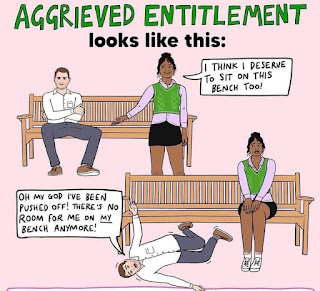
Source: https://twitter.com/vulgadrawings

What I really think is that y'all are just being super entitled, like the world has to revolve around you and what you want or what you think is "good" and "right". If I can put it in somewhat literary terms, you're acting like Dudley Dursley when he throws a tantrum because he had one less birthday present than the year before. 

Racism was somehow also brought up (I don't remember the exact context because those comments have apparently been deleted), so I might as well just address it because, for some people, just saying that "you really need to rethink this stance on inclusion" equals calling them racist. 

Do I necessarily think you're racist because you don't want diversity added to your beloved canons? No, though that really depends on why you are against it. (And usually how you phrase it.)

If it's for Story Reasons (e.g. the background/backstory doesn't make sense anymore, how did 2 white humans have a child of a different race without magic or IVF or gene manipulation or adoption or maybe plain adultery)... you know what? I'd likely agree with you that that specific effort was bad. The worldbuilding has to make sense, the narrative needs to be internally consistent. Sometimes people try to change things, but they don't go backwards into the history/lore quite enough. Good try, but I guess it didn't quite work out. 

But if your only objection is It Was Originally Written White So Changing it is Pandering To The Woke Crowd... or History! There Were No [Race] In History (when it's totally fictional, fantasy world)...

Let's just put it this way: the way some of you say that "inclusion and diversity is virtue signalling" tells me that really, you don't think I am a person. That I cannot exist except on your terms, when you want me to (probably when you need that token Not-White friend). That putting someone who looks like me into a fantasy story will always only be a political move. And not just a reflection of hey, the real world is made up of a bunch of different looking people, my fantasy world is going to be made up of a bunch of different looking people. 

You're telling me that I am a virtue signal and that don't deserve to have a story written for people like me. And that hurts. (Don't bother defending yourselves. It's okay really. I don't need to be your friend. You don't need to be mine.)

All that? Yes, that is racist. Even if you don't mean it to be. 

---

And since the group it was posted in is a Christian group, I feel like there's even more that should be addressed. 

First, I'd like to add that if you're complaining about not seeing Christians in fiction anymore or how Christians are always being portrayed as the "bad guy", think about how POC feel when there are SOOOO many books that do not have any POC, or if they are portrayed at all, are only ever the "bad guy" or the "comic sidekick" (with "comic" usually meaning slow, dumb, or useless).

But most of all, I suppose this is my specific gripe with White Christianity as a whole: that most times, when unity is sought, it’s taken to mean that one needs to conform to the traditions of the western church. In parallel, it’s like the Jews in Acts 15 insisting the Gentiles be circumcised, according to the custom taught by Moses, to be saved - forgetting that Peter addressed the apostles and the elders thus:

Brothers, you know that some time ago God made a choice among you that the Gentiles might hear from my lips the message of the gospel and believe. God, who knows the heart, showed that he accepted them by giving the Holy Spirit to them, just as he did to us. He did not discriminate between us and them, for he purified their hearts by faith. Now then, why do you try to test God by putting on the necks of the Gentiles a yoke that neither we nor our ancestors have been able to bear? No! We believe it is through the grace of our Lord Jesus that we are saved, just as they are.” — Acts 15: 7b-11 (NIV)

I wrote about this before here, so I'll not repeat the whole thing again.

But this insistence on Whiteness in a Christian group makes me wonder sometimes if we are truly following Jesus or if we are just following the White Man.

---

Anyway, Inclusion and Diversity. 

You know how they tell artists & writers to push through? That you have to get through the bad art and the terrible first drafts (or first dozen manuscripts) to get to the good stuff? That working through the bad takes is what will help you hone your craft? That right there is inclusion and diversity in the market right now.

People have realised a bias and a gap in the market, and they're talking about it. They've created such a buzz that the big publishers (and media companies) have taken notice. So they're pushing all of that out into the market right now, trying to ride on the wave. They're also probably overcorrecting or overcompensating to some extent - but then there's a huge structural bias to push against so that's probably why.

There's no doubt that some of this push is political - and companies wanting clout. That's okay. That's natural. But I think a lot of it is just people wanting to see their everyday lives (and faces) reflected in the media around them. So they're creating new stories (which often don't sell because saturated market) and also adapting old ones (which make a buzz because existing fanbase, many eyes, much money). 

Do they always get it right? No. Is that a bad thing? Also no. 

Does this change or somehow devalue the "classics" they were based on? No. Because those books/shows are still there

Do I necessarily want (or need) another old story rewritten with the White Male Protagonist changed into a Chinese Female Protagonist? Probably not. Because I've already worked through a lot of this for myself. And it doesn't quite affect me as an adult anymore. 

But you know, there are plenty of kids out there seeing all this stuff for the first time. And if this remake with Black Ariel or She-Hulk or Female Thor or racially-diverse dwarves (I don't even know what the objection is, actually) is what's going to give them that epiphany earlier in their lives, we probably would get through all the bad takes faster to reach the better, original, diverse fiction earlier. Because they would be starting at the place I took maybe 20 years to get to. 

At any rate, siapa yang makan cili, dia terasa pedasnya.

Wednesday, 3 August 2022

#bookreview: The Timematician: A Gen M Novel (Book 2) | Steven Bereznai

The Timematician: A Gen M Novel: Book 2The Timematician: A Gen M Novel: Book 2 by Steven Bereznai
My rating: 4 of 5 stars

What would you do if you could reset your life at any time you wanted, to (almost) anywhen you want to? You'd be able to do-over all the worst bits of your life - or maybe experience the best ones over and over again.

With this fascinating premise, Bereznai brings us the second book of the Gen M series, The Timematician. We follow Doctor BetterThan's mad plans for the best future earth, where all the annoying superheroes in Jupitar Island and all the dregs in the boroughs are dead. They're not longer trying to kill, control, or confuse him. This is the future where he has succeeded in his evil plan, leaving him as the only one left alive...yet is he really? Because suddenly he has a new nemesis: Mairi Lin Monroe and her bevy of lady-matons.

If you've read Generation Manifestation, it won't take you long to figure out who Doctor BetterThan is from that book (timeline), though there is a rather huge dissonance between the guy we remember from Caitlin's story to...this guy. (I did double take and go, "wait what? Did I remember something wrong?")

The Timematician starts off like a villain origin story, and yet as you live these timelines with him, watch him make mistakes and fall in love, and see him grow into the person he is/was in Generation Manifestation, your perspective shifts closer towards the hero origin story it should have been.

Despite it being called "book 2", I feel that it can be read as a standalone as the timelines have been so altered that you don't quite need to know what happens in book 1 to understand this one. It can even be read as a prequel, actually, since technically if you understand how this time travelling super power works, all this happened first.

While Generation Manifestation has a very strong YA dystopian, Divergent-like vibe, this one is just straight up snarky megalomaniac with super powers. It's funny yet awkward, and just a little bit sweet.

Note: I received a digital ARC of this book via Edelweiss. Opinions expressed in this review are completely my own.

View all my reviews

---

The Timematician just released yesterday! Get your copy now! :D

Monday, 1 August 2022

Saturday, 30 July 2022

#bookspotlight: The Keeper by D.L. Gardner

I "met" DL Gardner over on the Noblebright Alliance Discord Server and she mentioned that she has a Kickstarter going on for her new book, The Keeper! I haven't actually read the series, but it looks really cool. You can also get the earlier four books on one of the pledge tiers, or as add-ons. 

Here are the details! 

---

New technology. Stolen magic. The future invades the past like a thunderstorm wrecking havoc on a quiet farm

Just when things have quieted down in the kingdom of Prasa Potama and everyone is living happily ever after in their respective lands, invaders from another country, and seemingly another time in the future, steal the one thing that means life to the natives of Cho Nisi Island.

Their magic.

The ancient magic on the island of Cho Nisi is stolen, its tradition destroyed, and its protective shield ruined. But the destruction doesn't end with the broken drumbeats, nor the groan of the elders. King Barin is confronted with a vengeful adversary and a new enemy whose weapons far outmaneuver his army's bows and arrows, swords, and catapults. What have these strangers from the north come for, and will they battle for ownership of not only the kingdom's future but also its past?

The Keeper, book 5 in the Sword of Cho Nisi series, is a fast-paced tale of monarchs and ladies - wizards and dragons - and even a teenage boy who join forces against the miscreants and their machines, to fight for the beloved tradition of the elders.

Back The Keeper on Kickstarter!

---

With a passion for a good wholesome story, D.L. Gardner (Dianne Lynn Gardner) dives into the adult and young adult fantasy genres. She is both a best-selling author and an award-winning illustrator who lives in the Pacific Northwest, USA. Dianne loves a book that ignites the imagination, strengthens friendships, spurs courage, and applauds honor. Though she targets her stories for young adults, her books are enjoyed by all ages.

Website | Bookshop


Wednesday, 27 July 2022

#bookreview: The Monk Prince | Golda Mowe

The Monk PrinceThe Monk Prince by Golda Mowe
My rating: 3 of 5 stars

I've been sitting on this review, mostly because I do not know how to write it. I was rather ambivalent about Golda Mowe's first novel, Iban Dream, which was published by Monsoon Books. (I do not like most of Monsoon Books' list, so make of that what you will.) But I did quite like The Nanobots and Other Stories, so I figured I would give this one a try since it was published by Penguin SEA.

Ok look. Just because a book is published by Penguin Random House SEA doesn't mean it's good. I'm beginning to side-eye Penguin SEA and their poor editing quality (all outsourced!), strange cover decisions, and stupid pricing. I probably wouldn't be as annoyed with this book if it had cost the usual RM50 (-ish) for imported books instead of a whopping RM75. I'm not half as mad that I didn't quite like another local book I really should be reviewing because that only cost like RM20 (-ish. Can't remember what I paid for shipping). Printing in Singapore expensive kut.

ANYWAY. Back to the book itself.

The Monk Prince is an epic royal saga set in the Malay Archipelago in the 600s. Parantapa, raised by Buddhist monks to non-violence, is thrust abruptly into the middle of family drama when King Wayulo's spies finally find him after twenty years of searching. Not only does he have to adjust from a life of abstinence to one of plenty, he also finds himself an unwilling contender for the throne when King Wayulo discovers that his firstborn, Prince Alak Tegoh, isn't actually his biological son - meaning that Parantapa also has to give up his life of non-violence and learn to protect himself and his people. Across the sea, King Wayulo's brother-in-law, King Jayagapor, is looking to expand his political influence and increase his lands - and creating a war to put his nephew on Wayulo's throne looks like the perfect way to do it.

Filled with murder, betrayal, spies, and sea battles, The Monk Prince should have made for an enthralling read. However, the writing style creates an awkward distance between the reader and the story, leaving me feeling like I'm an observer from afar, rather than being able to immerse myself in the story world. In a way, it feels like actors merely reading lines instead of acting out and emoting the scenes. I suppose this is a preference rather than a fault.

There's also a slight feeling of disjointedness between scenes, as if the transitions are not quite right. This was especially obvious in later chapters when the scenes flip between POVs and the timeline becomes fuzzy. Does this next scene happen after the earlier one? Or are they overlapping? Why are we suddenly head-hopping so much?

For a book published by a major publishing house, it felt like the prose could have been polished much more. It starts off well, sags and drags a little in the middle, then picks up again with a lot of drama and action towards the end. There were also a few rather obvious typos, but well, typos happen. What irked me the most (maybe because I have struggled with this before) is the inconsistency in the titles & terms used. Within the same paragraph, Mowe switches between princess and puteri for Ming Zhu and between raja and king for Wayulo. Sometimes Megabintang is Queen, sometimes she is Rani. Gunawan is Commander in one line, then Panglima in the next. I think I fault the editor for this one.

As I said at the start, experience tells me that I may not really like Mowe's writing style, and The Monk Prince seems to confirm that. The story itself is solid, reminiscent of Udayasankar's Three. Despite my ambivalence as a whole, I do think that this is a book worth investing your time in especially if you do like historical fiction a whole lot more than I do.

I'm still annoyed at the price, though.

View all my reviews

Saturday, 16 July 2022

#review: Ignite Solo Performance Festival 2022 - Week 1

I guess FB ads do work. 

Ch'ng saw an ad on Facebook yesterday and so we ended up catching the first night of the Ignite Solo Performance Festival Week 1 at iBOX Theatre. Two performances, A Complete Woman and Kenapa Tak Tukar Nama, form Week 1's offering. Week 2 will be at Jetty 35, featuring Hujan Pagi and 11:11 A Tribute to Loving (V3).


Two questions immediately came up:

1) Where on earth is this theatre, why is the address in some office complex?

2) Got subtitles or not? 

First time at this space!

iBOX theatre is on the second floor of Sunny Point Complex and was relatively easy to find because a) they had the poster above right by the lift telling you where to go, and b) you can actually see the theatre itself on your right the moment the lift doors open. It's pretty small, black box style, and fits about 50 pax. (We counted 6 rows of 7 chairs in the main seating area, there were a few more chairs in front of the sound desk. They could probably add more in a pinch, but I don't know if there are still any SOP limitations.)

And yes, they have subtitles. They have all the subtitles. 

A Complete Woman

This monologue, written and acted by Suzanne (directed by Chee Sek Thim), explores the lifecycle of a woman from marriage and pregnancy to the birth of a daughter, coming full circle to the woman writing a letter to her eighteen-year-old daughter who is about to get married. 

It's a very heavy monologue, though it starts off somewhat light, talking about the blessings of getting married and being pregnant, and how everyone is happy for you. It also explores the different taboos and practices around pregnancy - and this was just between two different Chinese dialect groups (in this case Cantonese vs Teochew), proving that there really is no Chinese monoculture, even in Malaysia. Some of these points - including the part where she was stuck in GH and couldn't understand the nurses speaking in Malay - could have been funny, but presented as it was (by a woman who seemed to feel trapped in her marriage), it felt more like a panicked cry for help. 

Where it turns dark is when she talks about not being prepared - how the child was an accident in a moment of passion and how she desperately wanted an abortion because she was not ready for marriage and children. There's also a reference to her mother staying in an abusive marriage because that is her home and she will not let it go. It felt like a distorted point of pride for her at being able to "keep the family together", implying that the current rate of divorces show that these modern women are not tough or dignified enough to hold their marriages together.

At the end of it all, the daughter (and the audience) is burdened by the question: are you ready? Are you ready for the way that marriage will change you? Do you realise that getting married is not just being in love, but also having to adapt to and change for the family you are marrying into? Is your identity strong enough for that? Can you hold on to yourself through the pressures your in-laws will put you through, and emerge the other side still complete and whole? Does marriage make you complete or are you already complete before marriage?

This was the one I worried about because it's... Chinese theatre and I am a banana hahaha. A Complete Woman was mostly in Mandarin, with some Cantonese, Teochew, and Malay. There were English subtitles, but these were not very well done - ignoring grammatical mistakes, there were parts where the translation didn't quite make sense. In fact, there was this whole section that either wasn't translated or the projector got stuck, because the words didn't change.

Performance-wise, it was a good show, though I probably didn't get the full experience, being distracted by reading and figuring out the subtitles. But as I said, it was also very heavy-hitting, ramping up pretty quick and staying there for quite a while, so you get an overwhelming hit of raw desperation and not many other emotions. Maybe if you could understand the actual dialogue it would hit you differently. 


Kenapa tak tukar nama?

Hoe Mei Ying wants to get married to her boyfriend Zahari - and they've already gotten tickets for their honeymoon at 70% off during the Matta fair! The only problem is that she needs her new IC after her conversion to Islam, but JPN is delaying the process because she refuses to change her name. 

Yiky Chew's performance was brilliant. As a solo performer, she switches between different roles seamlessly, but also leaving the audience with no doubt as to which character she is playing at any point. I especially loved her portrayal of Puan Fatimah, the woman at JPN who interviews Mei Ying to try to convince her to change her name to a Malay one even though it's not required by law. 

Despite the hilarity of the situation and the way Chew played it up for laughs, it is also a very poignant piece. Zahari points out that no matter what happens, no matter her name, it's still just the two of them, in love. Mei Ying's parents panic (What? When did he propose?) and point out all the difficulties she might face, from being unable to eat pork anymore to whether her body might be snatched by the authorities in case of death. Mei Ying describes the goosebumps she had during the conversion ceremony and how surreal it felt. 

But Mei Ying's declaration of why she wants to keep her birth name is the one that resonates the most: the connection to her forefathers and the generations before her by the surname she bears, the love with which her grandparents had picked out her given name even if it is a very common name. And while she may change her religion and marry into another culture, these connections with her past, her race and ethnicity itself do not change. So why should she change her name? Why must she meMelayukan herself? (Muka masih Cina lol)

Kenapa Tak Tukar Nama? is primarily in English & Malay, though the section with Mei Ying's parents had some Chinese. There were subtitles throughout in both English & Chinese. I only looked at them at the points where they were speaking Chinese, so I have no major thoughts about them.

---

Both plays worked well together thematically, with their emphasis on marriage and its impact on a woman - whether through cultural norms or the inner workings of bureaucracy. One thing that stood out was the fact that both these pieces were biographical - it's not fiction or conjecture, not a simple "what if". A Complete Woman was written from Suzanne's own experiences; Kenapa Tak Tukar Nama? was developed by Chew and Syafiq Syazim (the director) based on the experiences of a friend as told to them by that friend and their family members.

There was a Q&A session after the two plays, which is not something I've ever seen done in English theatre. I don't know if it's a common thing in Chinese theatre? 

---

If you have no plans for today, do catch their performances at 3pm and 8pm. It's worth the RM40!

Pretty sure you should be able to walk in because the theatre was less than half full on Friday. Though if you want to check and reserve tickets, you can contact them at:

FB专页 / Facebook Page: Triple I Production House

电话号码 / Phone No.: +604 – 296 4353

WhatsApp: +6011-2070 6550

Wednesday, 13 July 2022

#bookreview: The Dragon's Promise | Elizabeth Lim

The Dragon's Promise (Six Crimson Cranes, #2)The Dragon's Promise by Elizabeth Lim
My rating: 4 of 5 stars

The Dragon's Promise picks up right after Six Crimson Cranes, so this review may have a few spoilers for that one.

Where the first book is solidly a retelling, this one ventures into its own path. Shiori has promised to return the dragon's pearl, so she sets off with Kiki and Seryu into the dragon's realm to do just that. But the dragon's pearl is a finicky thing, and its owner is not where, or even who, Shiori expects it to be. At the same time, Bandur is gaining power - and is angling to become the Demon King who will release the demons from the holy mountain and destroy Kiata (obviously by killing Shiori). So cue another adventure to return the pearl, save Kiata, and destroy the demons. And get married to Takkan.

I ended up liking The Dragon's Promise more than Six Crimson Cranes and it's not because I dislike retellings. I do love a good retelling, and I have done some myself. But where SCC just felt flat to me (I still don't get why everyone was raving about it), what I really loved about TDP was this parallel journey of discovery and redemption. As Shiori journeys to return the pearl, she uncovers the truth behind who her stepmother was and her motivations in setting up all that she did in SCC.

What I really hated about TDP was Shiori, because MY GOD DID SHE REGRESS. As I said immediately after reading the book:

COVID read #2: The Dragon's Promise - 4.5/5 stars. Super absorbing read but omg Shiori is SO annoying in this one. I liked her better with the bowl over her head.

— Anna Tan (@natzers) June 26, 2022


So if you do read Six Crimson Cranes, it's really gotta be for this one. Which is mostly villain stepmother redemption, if you ask me.

Note: I received a digital ARC of this book from Hodder & Stoughton via NetGalley. Opinions expressed in this review are completely my own.

View all my reviews

Wednesday, 6 July 2022

#bookreview: Six Crimson Cranes | Elizabeth Lim

Six Crimson Cranes (Six Crimson Cranes, #1)Six Crimson Cranes by Elizabeth Lim
My rating: 4 of 5 stars

I originally picked this book up because I saw it at Hin Market and remembered that everyone had been raving about it. I think it was all that raving that made me expect a little too much of it. At any rate, I will also put a disclaimer that I also read this while sick, so may be a little more irate than usual.

Here's my first impression:

COVID read #1: Six Crimson Cranes - 4/5 stars. I liked it, but I don't think it was worth how much it's been hyped up, prob because it has been overhyped. I think it was also jarring to have this lush Chinese setting and going but wait, I read this tale in a different mythology

— Anna Tan (@natzers) June 25, 2022


Six Crimson Cranes is an East Asian (I have been told that the names are more Japanese than Chinese, so idk, East Asian it shall be) retelling of an old European fairy tale--the plot seems closer to the German The Six Swans than what originally pinged my radar (the Irish Children of Lir), but if anyone's counting, it's definitely of that typology. Evil stepmother turns Shiori's six brothers into birds (cranes in this case) and curses Shiori and casts her out of the castle. The curse is two-fold. First, there's a magical bowl on her head so that no one can recognise who she is and second, if she talks or makes any sounds, her brothers will die.

Lim adds dragons and demons into this magical fairytale - not only is magic outlawed in Kiata, it's entirely gone because Shiori's ancestors sealed it into the holy mountain in order to bind the demons, guarded by priestesses. Except...Shiori has magic. And so does her stepmother. So. Holy war it is.

Six Crimson Cranes is Shiori's coming of age story, of how she changes from being pretty much a spoilt princess into someone of strength and honour through the hardships of her curse. It's also a love story, where she falls in love with the very place (and person) she once declared barbaric. She learns to look beyond outward appearances, to read unspoken words, to give second chances, and most of all, to put her people above herself as a true princess of the land.

It's overall an entertaining read, though I wouldn't rave about it. As you can tell, it hasn't made a big enough impression on me to actually...remember enough to write an in-depth review.

View all my reviews

Wednesday, 22 June 2022

#bookreview: These Numbered Days | Anna E. Collins

These Numbered DaysThese Numbered Days by Anna E. Collins
My rating: 4 of 5 stars

What does it mean to stay?

Annie Wolff has returned to Snohomish after eight years to make sure that her now-teenage children, Connor and Grace, are doing okay and are being taken care of by their aunt and uncle after the death of their father. She plans to quietly check on them, and then just as quietly leave--but her plans are thrown into disarray when Connor confronts her and asks her to stay.

So she stays, while planning to leave again. Yet the longer she stays, the more she finds that the picture-perfect family she'd always imagined for her estranged family is far from the truth. And the more secrets she uncovers, the more she realises that as broken as she is, she may still be the best person to take care of her children.

These Numbered Days is a story about living with depression. There's a bleakness that seeps out of Annie's point of view, revealing the dark days of her past. There's a sense of hopelessness, of knowing that this curse runs through the women in her family, and the expectation that one day it's going to take over Annie's life as well and there is nothing she can do to stop it.

And yet, it's also a story of hope and grit. Of fighting for better days, fighting for herself and for her family. It isn't a smooth journey. With every step forward comes a new setback. But with every setback, Annie finds a new way forward--with the support of her children and her landlord, Wic Dubray.

What I loved most about this book was the family dynamics. It isn't perfect--in fact, many times, it feels like they just keep breaking apart. But there is a raw honesty in how they try to reconnect with each other despite their hurts and imperfections. I'm a fan of second chances and third chances and all the chances--and this story is really about that: finding the strength to forgive and support each other, not holding their past failures against them.

I wasn't so stoked on the romance, but that was mostly because I'm just going meh, does there really need to be a romance? Must she really have a man in her life to be complete?

Yet the truth is, she doesn't have to do it alone.

You don't have to be perfect to stay.

Note: I received a digital ARC of this book from the author. Opinions expressed in this review are completely my own.

View all my reviews

Monday, 13 June 2022

#musicmonday: There Is a River | Jars of Clay

for all of your tears

are the wages for things you have done

and all of those nights

spent alone in the darkness of your mind

give it up, let go

these are things you were never meant to shoulder

Wednesday, 1 June 2022

#bookreview: Buried Talents: Overcoming Gendered Socialization to Answer God's Call | Susan Harris Howell

Buried Talents: Overcoming Gendered Socialization to Answer God's CallBuried Talents: Overcoming Gendered Socialization to Answer God's Call by Susan Harris Howell
My rating: 4 of 5 stars

Buried Talents was birthed from the question: If God calls women to pastor, why don't more churches have women leaders? 

And so Susan Harris Howell sets out to tell us why, or in her own words: to expose the subtle forms of socialization that pull women away from, and move men toward, leadership.

The title is tied to the parable of the talents and draws on Kristina LaCelle-Peterson's book, Liberating Tradition: Women's Identity and Vocation in Christian Perspective, which asks:
"Would the returning master of the household be mollified if the excuse for burying one's talent was, 'I got married', or 'My husband didn't want me to'?"
Chapters 1 to 3 cover what gendered socialization looks like in the different stages of growth from childhood to adulthood, how it affects the development of a child (whether male or female), and simply how pervasive it is even if it is unintentional. Even where parents may proactively reject gendered socialization in the home, by the time a child goes out into the world, they will be exposed to such messaging. It can also be as subtle as what stories get highlighted in the media, where "Men are the norm; women, the exception. Men accomplish in ways that are notable; women, not so much."

One thing I found myself ruminating over in these chapters was the point Howell made about identity and how many women, especially in church settings, do not have an identity of their own--because boys are told that achievement is a worthwhile goal in and of itself, but girls are often told that whatever they do, they will need to sacrifice it for their spouse. Why then pursue something only to have to give it up? She ties this back to the Fall, saying that "the imbalance in the husband-wife relationship is the natural consequence of sin", later saying:
"In the light of this interpretation, men feeling good about themselves when they are better than women, and women not using God-given abilities to their fullest in order to please men makes perfect sense. "
That's one interpretation I have not really considered before.

Chapter 4 is a fictional case study of how gendered socialization often plays out in real life. I found it to be very realistic --but felt that a concluding paragraph might have helped me understand what these stories were for. As it is, they just...ended and were never referred to again. And so...?

Chapters 5 to 7 offer suggestions and practical steps on how to overcome gendered socialization starting with the home and our personal lives. It also covers the wider societal spheres of church, work, and businesses, and how one can actively push back against gendered messaging, sometimes by just being persistently present.

I think I expected a little more exposition or teaching on what the Bible says about gender equality, but Howell's target appears to be egalitarian Christians; in talking about building a support network, Howell does advise readers to consider whether [a complementarian] church is the best place to serve, worship, and grow. It's also not written specifically to women--some of the suggestions cover how husbands can support their wives and work towards an equitable arrangement that ultimately allows both of them to live their callings.

While Buried Talents is written for Christians and is published by a Christian press, I felt that it could also be read and appreciated by a general readership that is working towards gender equality at work and in the home. Though there are some sections that are specifically targetted towards Christians and the church (especially in relation to pastoring or church leadership), almost everything else is generally applicable to pursuing gender equality and more women in positions of leadership: just exchange "God's call" for "dreams" or "ambitions".

Note: I received a digital ARC of this book from InterVarsity Press via NetGalley. Opinions expressed in this review are completely my own.

View all my reviews

Wednesday, 25 May 2022

#bookreview: All the Seas in the World | Guy Gavriel Kay

All the Seas of the WorldAll the Seas of the World by Guy Gavriel Kay
My rating: 3 of 5 stars

I was excited to start reading this because I remembered liking A Brightness Long Ago very much, back when I read it. What I didn't account for was the fact that although by objective time, having read that one in April 2019 isn't that long ago in book publishing time, I have forgotten everything I loved about that one except for vague impressions and, of course, my own review.

Which made for a frustrating feeling of not quite getting the impact that I should be getting out of this book. Sure, it's wonderfully written: a brilliant tapestry of many different yet ordinary lives that affect each other, of futures that shift and change with each person's rather humdrum decisions, whether they are the ex-slave Lenia Serrano, her Kindath merchant partner Rafel ben Natan, or the famed Folco d'Acorsi. I have also not caught up on any of the other stories set in this world--which, if looking at other reviews, might also have impacted my reading experience. This is despite the fact that All the Seas of the World is touted as a standalone. It may have been meant to be, but it didn't always feel that way.

All the Seas of the World starts with an assassination-turned-heist with a side of murder and unintended consequences. It ends with a siege and battle. In between, it explores the intersections of faith and race with identity--and how changing one's faith and name could change your fortunes, but also how faith is often tied to race and vice versa. It also looks at fate and timing, and how being somewhere at a certain time could make or break your future--and how our reactions and unexplainable impulses can set us on a different path altogether. But ultimately, it is also a story of revenge, of people being driven by revenge, and that thirst for retribution for past wrongs.

Like A Brightness Long Ago, the narrative shifts between POVs, though the majority of it is in Lenia & Rafel's POV (third person). But added to the mix is a first-person narrative from Danio which jumps out at the reader suddenly with no explanation, musings from the dying, an omnipotent narrator with Opinions, as well as strange foretellings of what is to come. I remember some of this from A Brightness Long Ago; I feel that I was okay with it then, but there's something about it that irks me now. Then again, taste is a subjective and ever-changing thing.

All in all, All the Seas of the World is a good, thoughtful read, but probably best read and enjoyed in relation to his earlier books. It may come across as a little slow and ponderous, though it is definitely not as repetitive as some of Brandon Sanderson's narratives.

Note: I received a digital ARC of this book from Hodder & Stoughton via NetGalley. Opinions expressed in this review are completely my own.

View all my reviews

Sunday, 15 May 2022

Sesi Seni with #PenangArtDistrict

I recently sat down with Swarna from the George Town Literary Festival to talk about my writing journey.

It actually came out a few days ago but I was too scared to watch it until now. heh.

Wednesday, 4 May 2022

#bookreview: Unspoken: Toxic Masculinity and How I Faced the Man Within the Man | Guvna B

Unspoken: Toxic Masculinity and How I Faced the Man Within the ManUnspoken: Toxic Masculinity and How I Faced the Man Within the Man by Guvna B.
My rating: 4 of 5 stars

Interspersed with Guvna B's own lyrics as well as his Instagram posts (unfortunately only the captions made it into the digital ARC; I assume the pictures made it into print?), reading Unspoken: Toxic Masculinity and How I Faced the Man Within the Man felt like sitting in Isaac's (Guvna B's real name) living room, listening to him ramble on about life, grief, faith, and therapy.

It may seem a little weird that I picked this up for review (thanks Netgalley!) since I am not black, British, or male. I don't even listen to his songs; I find rap music a little weird. But the church I attended in Uxbridge had invited him to one of their youth events in 2019 (which is how I remembered the name), so I was a little curious.

The super-long title makes it sound like it's going to be this thesis, but the book reads more like a memoir, with Isaac dropping all pretensions, even his stage name. It centres around his upbringing on a council estate in East London and his grief at the loss of his father and two close friends in the span of two years. It's also mixed up with race relations in the UK, clashes of cultural and familial expectations, and the burden of fame, to some extent. Yet it's conversational and extremely relatable, like an elder brother sharing a personal story.

Some quotes I found super relatable even as someone who's not anywhere near the book's target market:

[For the Asians (lol)]
I was comprised neither of flesh nor blood but of parental aspiration...

[For the artists]
I now know that what was happening was that I was trying so hard to put out what I thought people wanted to hear, without ever stopping to ask myself what I wanted to say, what was in my heart...
I started comparing myself to other people, which made me feel even worse.
Advice to anyone reading this: Never compare.

[For grieving Christians]
'Within modern Christianity,' [Justin Welby, Archbishop of Canterbury] said, 'we are really bad at lament and protest; really bad at saying, this is terrible, this is wrong, this is awful; and we're really bad at saying, "God I am really mad about this. I am so angry about this. God, I think you've let me down".'
What the psalm teaches us is that it is okay to rage against God, even though it does not come easily to us. It is better to rage against him than to shut him out completely.
In showing our true selves to God, he can reveal his true self to us. That is why lamenting and protesting in times of deep pain is as important as praising and celebrating in times of happiness. Learning to lament and protest is a journey towards better understanding God's love.


To be honest, while the storytelling prose is what makes the book, there were times when it felt like the author rambled on too far and then came back again with an, "oh yes, this was where I was going with this story". At the end of it all, he ties all the stories and the almost-devastation that came from those tragic events back to his own response, which was:

This ingrained sense of masculinity led me to believe that the only emotion permissible for me to reveal was rage. I could be angry, upset, hurt, or sad and then punch something, because that is what men did. Bare my teeth. Tighten my fist. Either that or grin and bear it. Handle it. Withstand the pain.


Overall, Unspoken is lyrically written, honest and heartfelt.

Note: I received a digital ARC of this book from [] via NetGalley. Opinions expressed in this review are completely my own.

View all my reviews

I didn't know this song was by Guvna B!

Saturday, 30 April 2022

#AtoZChallenge: Z for Zen

It has been awfully difficult to figure out a post for Z. I was thinking of going for ZZZ (sleep) but that was just weird. I’ve got nothing to do with animals (zoo) or even chaos and disorder. So I figured I’d go with zen, in the “peaceful and calm” meaning of the word, and give you a little excerpt of how and where Yosua finds some peace in the midst of the storm. 


Chapter 7 excerpt

The next few days pass in a blur. In the early mornings, before the castle wakes, I find myself sneaking out to the market, Relka trailing behind me. Relka has taken to sleeping outside my bedroom, no matter how many times I tell him I’m fine, I just need to be alone. I do need to be alone. I need to light the censers, to let the incense rise to heaven, to scream out my anger and fear and weariness to Kudus. I need to pray over their souls, releasing them to Kudus. 

O Kudus, please. Grant me strength. Grant me peace.

The Tawanan are a form of peace, if only because of their familiarity. They congregate in the northwest corner of the market, where several have set up their own stalls. I’ve visited them often enough during ‘market inspections’, just to see how they’re doing. 

The first morning I appear after my parents’ deaths, Uncle Dan stares at me wordlessly. He’s thin and grizzled, looking like he hasn’t slept in days. We’re not related by blood, though I call him Uncle. He was one of Ayah’s closest friends in Maha, always coming in and out of our quarters. I lift my hands, shrug. He nods and puts me to work. Relka gawks for a moment before he too gets ordered about. It takes Azman half an hour to blaze in, two Royal Guards on his tail, in a panic. Uncle Dan shakes his head but ignores their presence, as does everyone else, eventually.


###

And that's a wrap for the A to Z Challenge! Thank you for surviving this whole month with me! 

Every year, I say this is too much, I'm never going to do it again, but...I obviously can't keep myself from it for too long. I hope you've enjoyed this little peek into the Absolution series. If you'd like a look at an earlier form of this series, you can check out my 2018 challenge posts. hahaha. I believe Yosua had yet to exist, Mikal was still called Adam, and this book was supposed to be about Rahsia. *snort*

Head back to my theme reveal and master list.

Go check out the other A to Z Bloggers!


###

The Tale of the Hostage Prince (Absolution 1.5)

Yosua wears an uneasy crown. Although he is now Raja of Bayangan, he still longs for the land of his birth where everything was much simpler…and less deadly.

But peace doesn’t come easily, not for a twenty-year-old servant playacting at being king.

With his parents brutally murdered and his uncle bent on revenge, Yosua must decide where his loyalties truly lie. With his only remaining relative and the kingdom he has claimed? Or with his best friend Mikal and the sultanate that raised him as a hostage?


BUY NOW!

International purchases books2read.com/HostagePrince