Showing posts with label rant. Show all posts

Friday, 23 September 2022

Dear Malaysian churches, here's how to pretend to be more creative than you really are

Look, the easiest way to be creative (when really, you're not), is to hire a creative. There are many hidden creatives in your church, most of them not doing anything because you do not ask them to. 

Ask them. Better still, pay them.

Whether you pay them or not, most Christian creatives will usually feel, uh, led enough to offer their time to you for free or at a severely discounted rate because, church, you know?

When that isn't an option for whatever vague reasons you tell yourselves, remind yourself that stealing is a sin. So, whatever you do, DO NOT STEAL. Even if your intention is to give credit and skate along on the safe side of the applicable laws.

However, as they say, "Good artists copy. Great artists steal.

What? But you just said don't steal! Go read the article. I'll wait.

---

You back? Well, okay. Here is a super handy-dandy cheat sheet on how YOU as a Malaysian church can ultimately pretend to be OH SO CREATIVE by being inspired by Christian shows from America. Because honestly, one come-to-Jesus youth summer camp romance is pretty much the same as another, and as the author of Ecclesiastes says, there is nothing new under the sun.

There IS nothing new under the sun. 

The idea itself (falling in love at summer camp and also finding Jesus) is not copyrighted, but the execution of it is. First of all, here are a few DO NOTS you should adhere to.

  1. DO NOT under any circumstances copy all the dialogue and present yourself as the scriptwriter. NO. That is copying, that is stealing, and that is LYING. 
  2. DO NOT use all the same songs (or 90% of the same songs) from the show because that is being really, really blatant. 
  3. DO NOT use the same names la. Even if you change the surname, it's pretty obvious ok. Can don't be so obvious or not?

Why? Really simple. Because if there are sufficient similarities, even if you credit the original inspiration, people are going to be like, "eh, copy only. So same wan." Very not creative!

But you have an edge here, okay? Because once you localise the show, and I mean seriously localise it, not just change a few words, you have the best opportunity to pretend to be WAH SO CREATIVE HOW YOU THINK OF THIS?!

Remember: the idea of it is not copyrighted, the execution of it is. So take the overall idea and run with it. 

Ok ok, but how? Here are some very simple pointers:


Change the main character backgrounds

The Boy is in his last-chance foster home? Foster system WHAT foster system. It kind of exists in name la, but in practice??? In Malaysia, the Boy is more likely to go to an orphanage or group home, or even, say CPS. Even where places mention "fostering programme" it's more towards child sponsorship (like World Vision-style) and not USA-style where the child goes to stay with another family. Also, the government portal talks about "Probation Hostel/Asrama Akhlak" not "juvie" and they seem to jump directly from shelter homes to adoption (though foster child is mentioned once or twice). Also, the Boy is in trouble for stealing a cop car. Do people steal police cars? IDK maybe they do. But that is a very recognisable plot point. So change it. Make him a Mat Rempit or something. 

Then the Girl is the daughter of the campsite owner? Look, no one in Malaysia owns a summer camp, ok. We all just rent a hotel or maybe a campsite owned by some big church or NGO. So "owner of the campsite and daughter" doesn't make sense. Change it to the youth pastor and his daughter. Wah tension already. You want more tension? Try senior pastor's daughter. Bwahahaha.

The rest are teens, everyone's in school, not much is said about them so it's fine to just not mention it.

Just changing these two key background stories would actually already make your story different enough that it's not immediately recognisable.


Localise the jokes & language

Look, the reason it was ridiculous/funny that the Boy lied that they were "cousins" was because the Boy is White and the Friend & Camp Mom are Black. It's an obvious LIE. Your casting has two Chinese guys, cousin ma cousin lor, your church is 90% Chinese, what's the big deal? Find another joke that makes it obvious they're not actually related. Or think of another joke altogether. 

Your localisation must be thorough. John Hughes who? If it doesn't make sense to you because it's too American or too old, find something else that people watch which has the same "makeover" impact. The Chinese-Ed/English-Ed divide is also big enough a barrier - and probably more relevant in a local context. If the final connection point between Friend and his Love Interest is a quote from some super obscure show from the USA that no one here knows, find some super obscure show from Malaysia (or Singapore) that they can be crazy about and quote from. (I like horrible, terrible, vegetable as an inside joke, but that's just me.)

Malaysia is very multilingual. We tend to call things by their original names, whether they're in BM or in Chinese or whatever. USE THOSE TERMS. Lean into stupid bilingual puns. It's what your audience is used to anyway.

You have your own version of church camps, each has its weird points and competitive aspects. At my youth camp, we used to have marks for how tidy our rooms were, so there was a guy who SLEPT ON THE FLOOR so he wouldn't have to make his bed the next morning. What dumb things have your own friends done in camp? Draw from your own experiences.

You can also draw inspiration from scouts/guides camps and their chants! 100% relatable because I was never a girl guide but I've heard them in school and from friends anyway. 


Choose new songs

Keeping one or two key songs might work, but if most of the songs are the same, there's no running from the fact that you're drawing very heavily from the original. You probably don't have time to write your own songs because duh, otherwise you'd have written your own script, but you can find songs with similar themes that may even fit your revised script better! Plus, if you consider local songs as well, you have a wider range to pull from. Or, well, yeah BTS will work. 

You have to pay for the music license anyway, no matter what songs you end up choosing.


Actually adapt it for stage

A screenplay and a stage play are very different things. There are many things you can do on screen that you can't do on stage, and vice versa. So the act of just adapting the script for stage will already change key scenes and how they play out, maybe even the sequence of events. You need to figure out entrances and exits because you can't tell people to only look at one part of the stage. You can't have a quick montage of days passing or camp games that involve the beach and diving, but you can't just remove the scenes either because then the heavy lifting of character development and establishing relationships would then disappear with those scenes. You'll have to find another way to do it on stage. 

The Boy has a fear of heights but brags about the Blob (a high dive) because he doesn't know what it is? That's not something you can do on stage. Find something else that he could possibly be afraid of but brags about anyway because the Camp calls it something else. I dunno, some food he just can't stomach? 

If you've changed the location, you can't have that special garden anymore. But you can still have a special hangout spot, especially if they always return to the same campsite. It just won't be a garden she's tended for eleven years.  

---

Just changing these four things would lead to vastly different dialogue, which would lead to a very, very different execution of the idea, which is still Boy meets Girl at Camp and finds both Jesus and love. 

Is it a lot of work? Yes. Will it take a lot of time? Yes. Will it make you seem more creative than you really are? Probably, yes, depending on how much you actually end up changing.

Now, wouldn't it have been more worth it to write your own script in the first place?

Thursday, 11 August 2022

Inclusion and Diversity: A Rant

I have been struggling about whether to write about this but the anger and the bitterness are taking up too much space in my head, so maybe if it's written down in some form or other it will go away and leave me alone. For now. 

General life advice: never read the comments. Never, ever read the comments.

Even if they're on a post in a Facebook group that is, ostensibly, meant for...discussion. But what you don't read won't hurt you. And what you don't see won't send you into incandescent rage.

ANYWAY, this post is basically a response to a specific thread in a specific group, but I figured it's also a somewhat writing-related post which may (or may not, whatever) be helpful to people trying to navigate this whole thing around inclusion and diversity in fiction. I have been stewing over this since 29 July, so it's obviously not something I am about to just let go. I do not want to actually respond in the thread lest I BLOW UP AND RAGE QUIT. (I kind of like the other stuff that happens in the group so I'm trying not to rage quit at this point. Also, the admins and the founders have been kind and diplomatic and civil so I may just end up blocking a couple of people instead.) I also do not have the mental energy for arguing; my preferred method for dealing with confrontation is to walk. away. 

(But I am also passive-aggressive, hence this post.)

Note: It's been more than a week since I started writing this, the thread is quiet but reading it still leads to mild annoyance, so I suppose I will just finish the post. 

---

This whole kerfuffle started because someone had the audacity to say that adaptations to literature that make it more inclusive are a good thing

Which is, apparently, NOT the thing to say because all fantasy canon is holy and cannot be changed. (/s in case you weren't sure.)

Now, I'm not a very good fangirl. I find a lot of fannish things a little over the top and a bit too cultish at times. Example: I like LOTR but don't ask me to quote paragraphs for you. I'll probably never dress up like a hobbit, though we do joke that Penangites eat like hobbits. I do agree with many of the (other) comments that some recent adaptations *cough* The Hobbit *cough* were badly done because none of the additions made narrative sense. Yet...the most I'd do in response is go re-read the book and just never watch the movies ever again. I'm not a huge movie/series person anyway, so I'm probably not even going to watch The Thing they are obliquely complaining about. I'd also rather people write new stories with diverse characters and settings rather than remake old ones which are gender/race bent (sometimes the changes work, sometimes it's just...but why?) which is what many of them are pushing for. 

So, if I agree with so many of their talking points, why am I so bugged by the whole conversation? Because of the sense of entitlement and the overall tone of complaint that implies that Changing Anything In A Story By Adding Diversity Is A Personal Affront And An Attack On Me. 

I was going to post a bunch of quotes verbatim and address them, but for the sake of length and privacy, I'll just summarise their main points.


Changing the race of my favourite character steals something from me. Also, it's always a one-way thing; shows with predominantly POC characters are never rewritten to include/feature white people. 

I can't even begin to address the entitlement on this one. It's all "me! me! me!" here. How dare anyone make a story that's not meant for me?! How dare you make a story about someone else and not include someone like me?! /s 

There are many things in this world that are not made specifically for you, and that's okay! The original show still exists. You can go rewatch the original show and ignore the new one. Also, the point of this whole inclusion and diversity drive is to include people who have been historically erased from fiction (whether in books or on-screen), so reversing it to include MORE of the people who have millions of shows that reflect them...does not serve any purpose at all. 


We can learn to identify with themes in a story even if the characters don't look like us. 

Which is true! However, the commenter doubled down along the lines of "if I as a White Man can identify and learn from stories of other cultures, then POC don't need characters to look like them". Kudos for doing what we have always done. This totally ignores the fact that for many, many years, centuries even, everyone reading in English, of whatever race and ethnicity, has had to learn to identify with the White person and learn from their culture, so maybe it's time that we do not have to? That maybe, for once, it's nice to see a story we already love have people in it that look like us? To be fair, this was already addressed in the thread. It's just still annoying. 


Trying to make something that is for everybody cuts out diversity because some things just aren't relatable to some people.

First, nobody is trying to make something that is for everybody. They're just looking at a thing and going "hey look, the real world has a bunch of people with different skin colours living in the same place, plus a whole lot of people from different countries around the world enjoy this thing, so maybe this fantasy world should also have a bunch of different-looking people living in the same place". And if that makes a wider, more diverse pool of fans happy, that's what they want, isn't it? More people all around the world watching a show or reading a thing (and giving them more money)?

Second, I do not understand how that "cuts down the diversity". If the thing isn't relatable to you, just don't consume it. It doesn't mean that people should stop making it. I think that's a thing everyone else has already learnt. 


Making someone have a different skin color or gender doesn't make it more inclusive. My (white) sub-culture is rarely depicted well, yet I don't need a white woman to show up to enjoy the story. 

Great for you. If that's the case, then why are you so upset that someone Not White gets to be included in a story? I mean, we're not saying that we don't enjoy those stories either. In fact I'd say that sometimes we enjoy it so much that we (a general, inclusive we) would like to make adaptations of the thing so that other people who look like us can enjoy it even more!

But I'd like to reiterate that someone representing rural or homeschool culture wrong (which is a choice in most cases and something that you can change by say moving to a city or joining a public school) is different from someone representing your race with bad stereotypes (which is something you cannot change at all even if you moved across the world and had plastic surgery or skin grafts or whatever).

At any rate, I suppose this is a great segue into Personal Story Time. 

---

When I was a kid, we used to have these colouring books. I don't remember if they were princesses or fairies or whatever, but well, pretty girls in pretty dresses. And I was looking back at them one day (before throwing them out) and realised that the majority of the girls I coloured had blue eyes and blond hair. Which is weird because I'm 100% ethnically Chinese, living in Malaysia which is in Southeast Asia, an area that has a very minuscule percentage of blue-eyed, blond-haired people. 

When I started writing, I would hardly ever describe my characters. I'd use very vague, ambiguous urban settings so that they could be set in any large city around the world. Everyone would have an English name. I don't know exactly why. Part of it was this feeling of not wanting to set it somewhere local because it was...weird (shameful, maybe?) and boring. But I also didn't know where to set those stories - I didn't know enough about some random place in some foreign country to set it there (this was before the Internet was a Thing). Okay, I know why I did the name thing: it's easier to search a baby book for an English name than to create Chinese names, especially since I don't know Chinese.

Later on, I realised another thing. I could write short stories with Asian people in real life settings, but every time I started writing a fantasy story, almost all my characters would end up white or white-ish. Why? Because all the fantasy books I read growing up featured very eurocentric settings and characters. Fantasy was obviously a White People thing, Chinese people could not feature in them. It wasn't that I consciously thought this out - it was just there. In the back of my mind. Affecting all my creative decisions. I wrote about that in this guest post - how I had to deliberately make a shift in my head to base Amok in a Southeast Asian setting, instead of that "white default".

There was a related comment on the thread (that I can't find anymore) which stated something to the effect that if there are 6 white people in the show and one of them is changed to another race, but all of them think the same, that's still not diversity because they all...think the same. 

...and I'm like, I'm not sure you're even talking about the same thing that the rest of us are talking about anymore. (But maybe I'm misremembering it.)

But to kid me, if there were 5 white people and 1 Chinese person in a fantasy show or book, I would probably have had an earlier epiphany about my creative choices, even if it was just colouring that princess with brown eyes and black hair.

(I have thoughts about what diversity is, plus how second- & third-generation immigrants are usually closer to the culture of their country of residence than their culture of origin under the section "But what is diversity?" in this article.)

---

Someone reposted this on Facebook the other day, and I feel like this encapsulates this whole argument and why it's so grating.
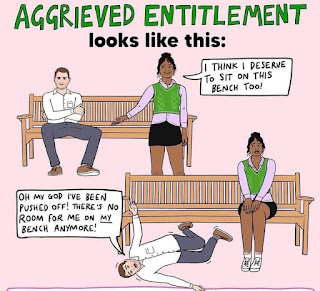
Source: https://twitter.com/vulgadrawings

What I really think is that y'all are just being super entitled, like the world has to revolve around you and what you want or what you think is "good" and "right". If I can put it in somewhat literary terms, you're acting like Dudley Dursley when he throws a tantrum because he had one less birthday present than the year before. 

Racism was somehow also brought up (I don't remember the exact context because those comments have apparently been deleted), so I might as well just address it because, for some people, just saying that "you really need to rethink this stance on inclusion" equals calling them racist. 

Do I necessarily think you're racist because you don't want diversity added to your beloved canons? No, though that really depends on why you are against it. (And usually how you phrase it.)

If it's for Story Reasons (e.g. the background/backstory doesn't make sense anymore, how did 2 white humans have a child of a different race without magic or IVF or gene manipulation or adoption or maybe plain adultery)... you know what? I'd likely agree with you that that specific effort was bad. The worldbuilding has to make sense, the narrative needs to be internally consistent. Sometimes people try to change things, but they don't go backwards into the history/lore quite enough. Good try, but I guess it didn't quite work out. 

But if your only objection is It Was Originally Written White So Changing it is Pandering To The Woke Crowd... or History! There Were No [Race] In History (when it's totally fictional, fantasy world)...

Let's just put it this way: the way some of you say that "inclusion and diversity is virtue signalling" tells me that really, you don't think I am a person. That I cannot exist except on your terms, when you want me to (probably when you need that token Not-White friend). That putting someone who looks like me into a fantasy story will always only be a political move. And not just a reflection of hey, the real world is made up of a bunch of different looking people, my fantasy world is going to be made up of a bunch of different looking people. 

You're telling me that I am a virtue signal and that don't deserve to have a story written for people like me. And that hurts. (Don't bother defending yourselves. It's okay really. I don't need to be your friend. You don't need to be mine.)

All that? Yes, that is racist. Even if you don't mean it to be. 

---

And since the group it was posted in is a Christian group, I feel like there's even more that should be addressed. 

First, I'd like to add that if you're complaining about not seeing Christians in fiction anymore or how Christians are always being portrayed as the "bad guy", think about how POC feel when there are SOOOO many books that do not have any POC, or if they are portrayed at all, are only ever the "bad guy" or the "comic sidekick" (with "comic" usually meaning slow, dumb, or useless).

But most of all, I suppose this is my specific gripe with White Christianity as a whole: that most times, when unity is sought, it’s taken to mean that one needs to conform to the traditions of the western church. In parallel, it’s like the Jews in Acts 15 insisting the Gentiles be circumcised, according to the custom taught by Moses, to be saved - forgetting that Peter addressed the apostles and the elders thus:

Brothers, you know that some time ago God made a choice among you that the Gentiles might hear from my lips the message of the gospel and believe. God, who knows the heart, showed that he accepted them by giving the Holy Spirit to them, just as he did to us. He did not discriminate between us and them, for he purified their hearts by faith. Now then, why do you try to test God by putting on the necks of the Gentiles a yoke that neither we nor our ancestors have been able to bear? No! We believe it is through the grace of our Lord Jesus that we are saved, just as they are.” — Acts 15: 7b-11 (NIV)

I wrote about this before here, so I'll not repeat the whole thing again.

But this insistence on Whiteness in a Christian group makes me wonder sometimes if we are truly following Jesus or if we are just following the White Man.

---

Anyway, Inclusion and Diversity. 

You know how they tell artists & writers to push through? That you have to get through the bad art and the terrible first drafts (or first dozen manuscripts) to get to the good stuff? That working through the bad takes is what will help you hone your craft? That right there is inclusion and diversity in the market right now.

People have realised a bias and a gap in the market, and they're talking about it. They've created such a buzz that the big publishers (and media companies) have taken notice. So they're pushing all of that out into the market right now, trying to ride on the wave. They're also probably overcorrecting or overcompensating to some extent - but then there's a huge structural bias to push against so that's probably why.

There's no doubt that some of this push is political - and companies wanting clout. That's okay. That's natural. But I think a lot of it is just people wanting to see their everyday lives (and faces) reflected in the media around them. So they're creating new stories (which often don't sell because saturated market) and also adapting old ones (which make a buzz because existing fanbase, many eyes, much money). 

Do they always get it right? No. Is that a bad thing? Also no. 

Does this change or somehow devalue the "classics" they were based on? No. Because those books/shows are still there

Do I necessarily want (or need) another old story rewritten with the White Male Protagonist changed into a Chinese Female Protagonist? Probably not. Because I've already worked through a lot of this for myself. And it doesn't quite affect me as an adult anymore. 

But you know, there are plenty of kids out there seeing all this stuff for the first time. And if this remake with Black Ariel or She-Hulk or Female Thor or racially-diverse dwarves (I don't even know what the objection is, actually) is what's going to give them that epiphany earlier in their lives, we probably would get through all the bad takes faster to reach the better, original, diverse fiction earlier. Because they would be starting at the place I took maybe 20 years to get to. 

At any rate, siapa yang makan cili, dia terasa pedasnya.

Wednesday, 14 September 2016

#bookreview: Giant Slayers by Jeff Altabef

Giant SlayersGiant Slayers by Jeff Altabef
My rating: 2 of 5 stars

To be fair, as fiction, Giant Slayers isn't half bad. It's got all the ingredients of a really exciting story. There's young David, a shepherd boy who's fallen in love with a Princess. There's King Saul, afflicted by demons that he doesn't dare tell anyone about for the sake of keeping his kingdom. And there's Michal, headstrong young princess, who's not content with just accepting the status quo. On the enemy's side, the Witch of Endor is calling on dark powers to assist her in getting revenge against the hated Israelite King. And there's Goliath - strong and beautiful - who is challenging the armies of God.

... I actually did like the characterisations of the Witch (I'm too lazy to look up how to spell her name now) and Goliath, and how the tension is built between the dark power of Molech and the power of God. It's a pretty good story-telling technique, fleshing out the "evil" characters which usually get passing mention. (Well, the Witch is an invention, so obviously she doesn't get ANY mention.)

[NOTE THE REST OF THIS REVIEW IS A THEOLOGICAL/RELIGIOUS RANT, SO IF YOU'RE NOT A CHRISTIAN/NOT INTERESTED IN THEOLOGY, YOU CAN STOP READING HERE. If, however, you are interested in accuracy and canon whilst retelling religious-based stories, do read on.]

Where it fails is as a Biblical retelling. Making God's power overly magical and mystical? Meh, not a favourite of mine but it's been done, not a big issue. Adding in a forbidden romance? Sure, why not? It's canon anyway. I don't know if it started then (it's mentioned only much later), but it could have. Random access to the Ark of the Covenant at King Saul's palace AND King Saul being able to plate it with "tainted gold"? What? Did you not do research? Saul would already be dead. You're not supposed to touch that thing! Painting Samuel the Prophet as an outcast/rebel? Um, well, I suppose it's within the bounds of plausibility; Samuel did not ever see Saul again after rejecting Saul as king, apparently. But recasting David's motivation for facing Goliath as being just to win Michal's hand is pure character assassination. And then forcing him to choose between saving the kingdom or being with the girl of his dreams in some magical time-stopping event?? Eh. No. Just no.

And that's my main gripe.
Biblically, God has rejected Saul as King because he's disobedient to God. There's that whole bit in 1 Samuel 15:22-23 where prophet Samuel scolds Saul:
“Does the Lord delight in burnt offerings and sacrifices
as much as in obeying the Lord?
To obey is better than sacrifice,
and to heed is better than the fat of rams.
For rebellion is like the sin of divination,
and arrogance like the evil of idolatry.
Because you have rejected the word of the Lord,
he has rejected you as king.”

David was anointed to replace Saul, because "the Lord looks at the heart" (1 Samuel 16:7). He's described in 1 Samuel 16:18 as "...a brave man and a warrior. He speaks well and is a fine-looking man. And the Lord is with him." Which basically means that David is a fervent believer. He's not one of those I'm-just-doing-this-culturally Israelites. If you want to put it in modern terms, he's a practicing Jew. Or, if contextualised, a born-again, church-going, tongue-speaking Christian. He's chosen and anointed because he knows who his God is.

In this story, David has no concept of who God is from the very start. He fights the lion and the bear to save his sister and is "magically" saved by some bizarre white flash of light whose source is unknown. If he were to build that "coming to know God" into the story as it unfolds, fine. Shaky, but fine. Instead, David is crazily impressed WITH HIS OWN SELF AND HIS OWN LUTE PLAYING which summons "birds of light" to fight the "dark snakes" plaguing King Saul. AGAIN, with no concept of God, except something along the vague lines of... "maybe it's God? But I don't know. There's some strange power thing that happens when I play" and "I'm special. Some higher power is saving me for something. Oh wait, yes, that random tatty seer who looks like Samuel says I'm going to be king."

Oh, but randomly, before the battle, he is able to spout stuff about fighting for God and God saving them, even though when he goes to Saul to insist he should fight Goliath, the only thing that's on his mind is "I must do this so I can marry Michal." God wasn't even a consideration. Which is so totally off course, because David's true reaction is one that's more towards righteous anger: "Who is this uncircumcised Philistine that he should defy the armies of the living God?"
And making him steal a horse?? And lie through his teeth?

I usually don't mind minor variations or little tweaks for the story's sake, because that makes a retelling all that more interesting. (There were quite a few of those which I haven't mentioned because eh, who cares.) Humanising Biblical characters with a little bit of doubt and wavering and adding romance is fine. There's room enough in the stories for you to add those, especially when it hasn't been said/inferred/spelled out in any way because you don't know ANY of their thoughts anyway. All you know are their actions and words as written. But changing a fundamental principle of the story? Total character assassination of the main character himself? No. Just no.

Other annoying bit - not so very much theological - is the fact that David, as a shepherd boy, has no fighting skills whatsoever. He literally can't use a sling or a staff to defend himself... which doesn't make sense because he has to protect his flock. This story makes it seem like the one lion and one bear that attacked him was a fluke, and it has never happened before. Yet he boasts of never having lost a sheep. Uh, right. Besides wild animals, there are raiders and bandits and such. I'm sure that even as a shepherd boy he should already have developed some defensive skills, even if he's not depicted as a soldier with sword and armour. (Also note "warrior" description above.)

Ah. I should stop here. To summarise, eh, needs more research.

Note: I received a free digital ARC from the author in exchange for an honest review.

View all my reviews

Sunday, 21 February 2016

On missing the pizza for the mushroom

When you think about it, all you're having is really a food tantrum; a spiritual food tantrum, if you will. You're the kid at the buffet who's decided that the only thing you want to eat is spaghetti when there's also roast chicken and fried fish as mains, besides chocolate cake, fondue and ice cream for dessert, but no, you've decided that spaghetti is important and you're upset because it's not filling enough nor is it what you expected it to be.

But you know you're a self-feeding adult - well, at minimum a teenager - and you can find your own meals if you need to, but you aren't, because you're in a tantrum and you can't see the rest of the pizza for stressing over the stupid mushroom that you hate. Because underneath it - underneath it is that old scar, isn't it? It's that bleeding wound that says I'm tired of always giving and never receiving. I'm tired of being mature, of being wiser, of having to be nice. I'm tired of having to put others first because that is what good, Christian girls do. I'm tired of never getting attention or care because I'm supposed to be okay. I'm supposed to know how to get it right.

So you refuse to be responsible because there comes a time you deem self-care as more important than care of the community and love towards people. You want him to fail because you want him to own up to pushing responsibility on others all this while; you don't want it to fail because it has been everything you've cared about for a long time. And you hate yourself because you know you're being selfish and immature and you know you can't go on hating people even as you also know you cannot stand working with them anymore. You've reached your enough, but you cannot let go because this is not what it should be. Thus the conundrum: do you keep at it, getting more stressed by the week, or do you let it go and hope that everything doesn't fall apart?

And you let go because you should. Or, at least, you think you should. You know it's a tantrum because you are afraid. Because things are changing and you hate change. And you need to let go but you can't, so you make a storm in a teacup to assuage yourself and to calm your nerves because everything is too much but too little.

Yet behind it all, you remember: you don't have to rely on anyone to feed you.

You've been waiting for someone to lead you, when all along, you could have led yourself. And you should have. but you haven't.

---

On the other hand, community matters. 
But how much does it matter - to you - anyway?

---

So you weigh the line between feeling used and being entitled and you don't really know where one ends and the other begins, because you feel that you've been used, and you think you're entitled to - to what? You're not quite sure either - but at the same time you know that this isn't what leadership or servanthood is about.

You know that the institution has failed you, as all institutions do, and it's funny because you've said often enough that you don't believe in church, the institution, anymore and yet here you are, still railing against it. But it's difficult to search out Church, the Family, on its own, because it's all tied up in the institution and it's hard to separate something so closely intertwined.

Yet you must.

And really, what it means is that you've lost sight of what really matters. Because your eyes are too blinded to see the truth: that as much as it seems to be about him, it's more about how you deal with him and those like him.

That's not even the main thing.

The main thing is that you've lost sight of the cross. You've lost sight of the sacrifice that makes any of this worth contemplating. And true, whilst your community holds a burden of mutual care, your care doesn't depend on you and you alone either. It's not them or you. It's not just giving or just taking. It's stepping outside this vicious cycle and remembering that it's all been done. It's all been won. You don't fight in vain. You fight from a position of victory.

And your care? That's between you and Jesus.

Friday, 10 July 2015

This is not working out

We are too abrasive together and not in a good way. Not in the way where we fight and we argue and then we see sense and then we make up. Not in the way where we are frenemies and hate each other but cling to each other because we know fundamentally that we are on the same side, heading the same way.

No.

You poke and I flare and words fly and nothing gets resolved. There is too much anger and too much hurt. There is too much frustration. All on my side, I know. Because this is my fault and I am a horrible person. I am immature, I know. I cannot control the suspicions I have against you and I hold you at arms length because I do not trust you and I do not trust what you do or what you say. I find it difficult to work with you or to follow your lead because I do not see that you are leading. You are bullying. You turn every conversation towards you, even when you are supposed to be building us and edifying us. I do not see how you are growing us. Maybe it's my fault. I am already prejudiced against you.

You said God put you there.
I know I am not meant to do this.
So no matter how much you say you need me to take this up, I will not. I cannot. I will not push aside my calling again to serve yours. I will not misalign my focus for you. If this is a limb I need to cut off, I will.

I will bear this burden of irresponsibility if I must. I have said too much and overstepped my bounds and been deemed too harsh because I have cared too much and care, for me, equates to responsibility. This means protecting my people, not burdening them. To give them fair and equal voice, fair and equal choice, not to be summarily told what to do in that bullying way of yours. But I cannot hold so many threads together and I do not have the capacity to care so much, not if it includes you in the picture.

This is not my burden to carry. This is not my responsibility to shoulder.
I need to remove myself from this toxic situation, so this is where it ends.

Or rather, this is where it does not begin.

Sunday, 17 May 2015

Redeeming the arts, not just reviling it

We had this seminar today which cued a lot of eye rolling and snide remarks from me. Because I am a horrible human being. I am not afraid to admit that. Haha. I was wondering if I should start a rant about it and then I got distracted and then I decided maybe not. But I'm here now. Typing. So.

I guess the most important thing I have to say about this whole... whole.. thing, is really this:
If your God is greater, stronger, mightier, more powerful, omnipotent, omnipresent, redeemer, higher, creator and ruler of all, don't you think that you have nothing to worry about?

Because at the root of it all, this is blatant fear-mongering. If I may be so bold, I would say that whilst it is true that symbols do have power and we should be careful about what we watch, read and listen to, going witch hunting for symbols in everything in the world is not useful in any sense. Look - if you really want to find something, you will find it. You can fit anything into your theories after the fact, but is that really what you want to do? [DUH TRIANGLES AND CIRCLES EXIST EVERYWHERE HELLO! BEE HIVES AND OWLS AND LIGHTING BOLTS WERE CREATED BY GOD DUH] If anything, it's only going to create a culture of fear whereby you might as well go live in a cave or become Amish.

You think the Chinese are superstitious? Try the Christians. *rolls eyes*

Okay - so you can point out a gazillion examples of how the media is influencing us in the wrong ways and throw out statistics like how there's only 4% of homosexuals in America vs 40% evangelicals but how they are over-represented in media (I'm just dumping numbers off the top of my head from what I remember was said - not sure if they're correct). Why is that, you ask?

WHY IS THAT?

Because the people who have gone before you, and who have put all this "information" on the net for you to "research" and "preach" about, have done a very fine job of scaring off the Christians from the entertainment industry so that there are NO PRODUCERS OF GOOD CONTENT LEFT.

And by "good" I don't just mean "quality" - I mostly mean wholesome (though if wholesome isn't very entertaining, it's also not very good).

The answer to deception and manipulation by the media is not to run away. It is not to cry foul and say "how can you produce such awful, evil things! Remove it from our sight! We are so holy we can't see this! It's a bad industry! Stay away from it!" The answer is not to pull ourselves out of the world and refuse to get involved.

The answer is to counter-produce - to flood the market with good, holy, wholesome things that will inundate the industry with good. The answer is to give the people a choice. To put God back into the culture and references of the world. They may not always choose the good - but if there is no choice, then there is no conversation, and what are you complaining about?

It's no use to only always ever be pointing people away from something. People need something to head towards. So if you're going to be warning people about how bad the entertainment industry has gotten, you had also better be able to start pointing those same people to good examples of how the entertainment industry can and has changed the world for the better.

After all, isn't that what redemption is all about?

Okay. So I ranted. Sorry, couldn't help it.

The point here is this: we need to change the narrative that says
"we pull ourselves out of this [sphere] because [all these bad things] are happening, and all the people involved act in [these certain kinds of ways that we disagree with] and we don't want to be influenced by them" 
and instead say
"despite all the [things we disagree with] that are happening, we will continue to be involved in this [sphere] in order to be able to influence them for good because we believe that God has called us to redeem His creation by our presence in this [sphere] and among these people."
Because then, and only then, can we really make a difference in the world.

[andohpleasenomorecrappydeathbedconversionformulastoriesthankyou]

Sunday, 19 October 2014

Becoming Holy: a continuum.

But you see, holiness is really a continuum.

Yes, we know that we are made righteous through the finished work of Christ, and that His blood has covered  all our sins, making us holy in His eyes. But that's the end game. That's the final judgement. In this life, in this plane of existence, we're not there yet. The Bible says "be holy as He is holy." (I Peter 1: 14 - 16) If we are already holy, that wouldn't be an instruction. It would be a statement: You are holy as He is holy.

It says be. That implies becoming.

It means that we live a continuum between holy and sinful, somewhere between saint and sinner, neither one or the other; both at the same time. Our religious binary says that it cannot be so. It tells us that you can only either be a saint or a sinner, good or bad; you cannot be both.

And yet we are.

Because even as we succeed day by day, we also fail day by day to live up to God's standards and that is the struggle, the battle that we have to live in. At this point of time, in this very second, you could probably say to yourself, "as far as you know, I'm living right. I'm in the perfect will of God." And yet ten years from now, if you're still alive, the likelihood is that you'll probably look back on this very moment and say, "Oh God, how wrong I was! I was such a sinner."

Because we are still becoming. We're on a journey. We are not there yet.

The problem is that we cannot accept this truth. So we turn away people who are struggling more than us, with sins more obvious or "awful" (in our eyes) than ours, saying that they cannot join the club until they've turned away from their sin. Except that the only way they can fully turn away from the sin that plagues them is through the grace of God poured out in their lives and experienced in the body of Christ, where they are given worth.

And there is that excuse, of course: I'm only human. 

Of course you're only human. That's what God made you to be. You'll be susceptible because of the fall. You'll make mistakes. You'll change your mind. You'll fall over and over again. You'll get into messes and blame everyone and everything around you. You'll have raw instincts that move you to aggression and hate and lust. You can always claim, "I was born this way. I don't know any better!"

And yet the truth, oh the beautiful truth of this remains: You are human.

You have a choice. You don't need to give in to your baser instincts, though sometimes you will. You don't need to follow whatever the world tells you you are. Because you are a rational being with free will, and as freely as you can decide to do wrong, or to continue living where you are, you can just as freely decide to live one day better, live one day a little more righteous, live one day with a higher expectation of yourself. And even if you fail on that day, you can decide to live that way again the next day, with the full grace of God covering you, until one day you realise that you've won that battle.

And that is the grace the church needs to extend.

Not a political correctness that says "It's alright to live in sin. We welcome you anyway."
Not a righteousness that says, "We can't accept you because you're gay/you don't live right/we don't like your lifestyle."
Not a permissiveness that says, "Look, come in anyway, and you can do whatever you want in the church."
But a church that looks with love and says, "You know that we hold these standards. We understand that you struggle. Let's struggle together and see if we don't come up on top of it. Because while God is holy, he is also merciful. And the grace and forgiveness He has extended will continue to cover you, even as you come to know Him. And we believe that as you come to know Him more, you will be changed by Him, and your battles will no longer be your demons, but your victory grounds."

Because that is where we all live, regardless of our sin.

In the continuum of sin and holiness.

Wednesday, 1 October 2014

On the contrary, my dear...

I would like to suggest that you're not lazy.
You're just dragging your heels because you refuse to do what needs to be done. Partially because it would mean that you have to give up some (most) of the ways you enjoy wasting time and partially because it will open you to a whole new level of rejection, dejection and depression.

Because you know that you will never always be good enough.
Because you know that you will never always know what you're doing.
Because you know that you will never get the kind of validation you need because it doesn't exist.
Because you know that you will start hating yourself more and despising your talent more and criticising your work more the more you create, especially the more you can't create.

And you hate that level of insecurity.
You hate that level of inconsistency.
Most of all you hate that you need to change, because change is scary, and unfamiliarity and fear is what makes you insecure.
And you hate that.

So you drag it out over the years, taking one tiny step at a time, always wondering why you never move.
But you have.
And you can't go back.
Yet you refuse to move forward.

So you rant and have panic attacks in the middle of the night, kicking against the establishment whilst complaining that no one supports you and no one understands, and everyone is not where they need to be in an effort to not have panic attacks in the middle of the night because everything is moving too quickly and you're not prepared to GO.

So you say you're lazy.
Because you don't know how to move.

Sunday, 2 October 2011

Post camp post: being true to myself, a writer.

We had this session during iBridge camp about discernment, i.e. knowing the will of God. I don't have all the notes (I stopped jotting when they said they would get the slides to us, but I haven't seen them yet) but there was one thing that really struck me that day.

One of the guiding principles of discernment is to stay true and truthful to who and whose you are in Christ. 

There's a lot of stuff floating around about knowing yourself, being true to yourself, standing up for who you really are, and not all of it is Christian. In fact, most of it is rather post-modernistic, individualistic, let-me-do-what-the-heck-I-want-so-get-out-of-my-face-God (or maybe I'm getting the wrong kind of vibes here). But more often in the Christian circles, there's a lot of thing about finding God's will, focusing only on God and ignoring ourselves (we are nothing, we are nothing, we are nothing - kind of Buddhist, no?). True, Christ must increase, and we must decrease, but does that mean we ignore everything that our passions and inclinations drive us towards?

What does it mean to stay true and truthful to who you are? (Let's ignore the other bits for a moment.) Who you are matters, because God made you that way. If you are an engineer, you worship God through your engineering skills and making that no one gets killed by a bridge falling down or a phone blowing up or... something like that (I get a little fuzzy on details because there are so many kinds of engineers). If you are a doctor, you worship God by helping people get well, or at least by easing their pain until it's time to go. If you are a lawyer, you worship God by helping innocent people get their lives back and assist in disseminating justice where it's needed (though it may seem rather arbitrary at times). If you are an accountant or an auditor, you help ensure that the companies don't cheat money off their investors and the employees don't defraud their employers (to what little extent you can). But if you are an artist, or a writer, or a dancer, or anything to do with music and creative arts, it suddenly seems that you can't and aren't doing anything productive or useful unless you are leading worship in church, or decorating the church, or doing an Easter or Christmas production.

WHAT GIVES?

Why is every other profession more important to the body of Christ than the very professions that have the most impact on our daily lives?
And this is where I get into the rant mode, sorry.
I'm tired of people acting like it's SO easy to get a good story down on paper/screen, and to edit it. Like it can be done in a day. Yes, you can get 50,000 words out for NaNoWriMo in a month but that doesn't mean the story is good enough. It doesn't mean the writing is tight enough. It doesn't mean that you're done with it yet. And all this takes time, people. Time I do not have working a 8.30AM to whenever job.
I'm tired of people thinking it's SO easy to put a good play or *gasp* musical together. Like it can be put together in a week. Yes, you can have once a week practices for a month and do a decent play. But if it's anything longer than 5 minutes and you're working with a bunch of amateurs, or people who are just acting for the sake of it or because there is no one else, then it's not good enough. I'm sorry if I'm sounding condescending - I'm not the best of actors or directors OR playwrights - but it takes time to put stuff together that will be worth watching, and frankly half the stuff that comes out on church stages are not. Time I do not have working a 5-day, but in reality 6-day week.
I'm tired of the slipshod way we approach worship in church, like a two-hour anything-goes practice session is good enough to pull together a team that only plays together once in three weeks, and then expect God to DO SOMETHING WONDERFUL. Yes, He can, and DOES. But at the same time, is this what you really want to offer Him week after week? Because it is an offering, isn't it? It's not just "leading people to worship" it's also an act of worship in itself.

Where does this take us again? Well, it takes me back to the core question - who am i? 
What drives me? What makes me tick? What makes me stay up all night? Pulling aside all that I do and try to do, what motivates me?
This. Writing this. (It's 12.32AM now, despite the fact that you'll only see this on Sunday, 9AM because of the power of blog scheduling muahahahah and I have to get up at 6AM tomorrow to catch a plane.) Writing Friday Flashes. Receiving good and not-so-good comments. Trying to figure out which WIP to start editing, because I can't always sit on them until they grow stale and annoying.

And if this who I am is rooted in whose I am, doesn't that really mean that I'm a writer plugged in to the greatest Creator the world has ever seen? If I stay true to who I am and whose I am, doesn't that mean that I've already found my purpose and direction in life? Doesn't it mean that I don't have to keep asking the question, But God, what do you really want me to do?, as if I'm sure He's going to ask me to do something I cannot do or go somewhere I really hate just because I can't believe that He made me love writing so that I can write?

How does this translate into real life? 
I don't know yet. The two-year plan was to wait it out until David graduates and then see what happens. My mum insists it's a maximum one year break, to study some course or other in creative writing and/or creative arts. That may be part of the plan. I don't know. It's the first step I am looking at, just to redefine where I am.
Then again, it may be shorter. I don't know, there's this restlessness. There's this itch. There's this perpetual question (eh, so when are you going to resign? What, you're still at the same firm? Me: YAH, I know I'm loyal!)
But I'm ready, here and now.

Tuesday, 6 September 2011

Piracy: The complex Malaysian Christian stand

So I was talking with this guy, Caleb, at my cousin's wedding dinner on Sunday night and we somehow got from music into books and into piracy (the copy-your-content-and-sell-it-cheap kind, not the Captain-Jack-Sparrow kind) and online file sharing.
And you know the thing about piracy is, it's not good. It's not nice and it's not Christian. To put it harshly, it's stealing. Sort of.

I mean, I write. I post stuff online. Right now, all of it is free, because most of the stuff I do is blog. Or write articles for people. But I would really like to write a publishable novel, and I might go the e-book route through Smashwords or Amazon. And if I do that, I would really like all the money for those sales to come to me. Like, if each person were to buy an e-book and the royalty comes to me, rather than say if A buys it and then passes a copy to B who passes a copy to C.
Then comes the other thought - what's so different between that happening with an actual print book and that happening with an e-book? I mean, I often borrow books off other people (which is, in fact, A buying the book then passing it on to B and passing it on to C). The difference is - there is only ONE actual print book, as compared to THREE different copies of the digital version.
And how about buying second hand books? I buy A LOT of second-hand books. The money still doesn't go back to the original writer/publisher, does it? It's all very complex. Why is the re-selling of second-hand books legal, but the re-selling (or sharing) of a digital version not? The argument goes back to the number of copies of the book available, doesn't it? There will only always be one ORIGINAL copy of the print book (let's not talk about making photocopies) whereas, there could be many, many copies of the digital version by now.

I also sing and act non-professionally. I know the amount of time and trouble it takes to get things right. Writing a song is a work of art, crafting everything together and getting the arrangements in shape is not only time-consuming, it's expensive if you're going to hire out. It's not good enough to say that oh, but the singers/actors/production houses are so rich anyway it's not going to make any difference to them. The reason they are able to get rich is because they sell A LOT of albums/shows. If you're a new artiste, fresh off the racks, in all probability you're not going to make enough to break even. If you pirate every album or movie you come across, there will be NO industry left because they won't be able to cover any of the costs! Yes, burning a copy of the album is super cheap. But the technology and the time and the effort it takes to come up with the original product is not insignificant.
A music album would need at minimum the band and the singer(s), the graphic designer (to come up with album art or at least the little logo thingy if you buy it off itunes), the composers/song writers (assuming that these songs are not written by the band/singers themselves), the guy who does the musical arrangement (may or may not be a separate person) and the sound engineer (or whatever you call the person who mixes the sound together) - I'm probably missing out a lot of other people (marketing, maybe) and don't forget that while they're doing all this stuff, they need money to keep themselves alive. Then there's the equipment - piano/keyboards, guitars, drums, whatever other instruments are being played, sound desk and all the recording devices, microphones, amps, mixing software...
True, you could probably do without a lot of these and record everything off your laptop, but the sound isn't the same, is it?
A movie? There's the director, producer, actors, cameramen, gaffers, video editors, computer graphic-y/animation people, costume designer, music director... if you've ever stayed to read the credits THAT'S A LOT OF PEOPLE INVOLVED. Let's not start on equipment.

And yet, the thing is, I don't think many Malaysians realise this. It's just a movie to watch, or an album to listen to and if you can get a perfectly good copy for RM4 where the whole family can watch together, why bother going to the cinema at RM8 - RM10 per person (imagine if you have a family of 5) or an original VCD/DVD which may be between RM30 - RM50?
I admit, I do hunt for bargain VCD/DVDs (often priced between RM12.90 to RM19.90). Nothing wrong with that - it's still the original. I don't know how the royalties/payments work that way, but I'm still buying the original product. (I suspect the distributing shop takes the hit, but these are usually obsolete/old/overrun/written off stocks anyway).
Actually, scratch the "Malaysian". I don't think most of society realises this anymore. The concept of paying for value has kind of gotten thrown out the window in recent years. There's so much free stuff around that people feel entitled to having other stuff free, and get outraged when they're asked to pay for it. What's so hard about doing all this artsy stuff anyway? is the kind of reaction you get, as if writing a book can be done in a day. Or writing a song is just a hobby. It may be a hobby for you, but it's a livelihood to others. And if they don't get paid, they can't continue giving you the content you want.


The problem for me, as a Malaysian, is that it's pretty much a way of life, a culture almost. Music and movies are often overpriced for the average person (especially if you're a student) and I admit to having copied music/e-books from friends before. And sometimes there are some great stuff that doesn't come here officially/legally and the only way you can get hold of it is through online file sharing (or the local pirates).

And there's that saying that if your stuff gets pirated and sold on Batu Feringghi, that's when you know you've made it as an artist...

So I don't know. It's wrong. It's plain confusing.
It's a stand I suppose one has to make and I'm trying to. It's difficult.

Saturday, 2 July 2011

Annoyed: Chicken & Duck conversations

I suppose what irritates me the most about this whole Bersih thing (actually Malaysian politics in general) is the whole atmosphere of arrogance and pride. On both sides.

PR has the arrogance of a popular online support. I don't know about on the ground, but online, yes. Their demands may be righteous, but their tone smacks of arrogance, not of righteous anger. It's like a come-uppance. I'm right, so you had better agree with me.
BN has the arrogance of power and money. They know that they have the power of the ruling party and the power to stay in power due to money politics and corruption so they couldn't care less about what anyone else has to say. Any pretence of it being all due to perception is probably down the drain with this whole fiasco with Bersih. Perception? What perception?

Everything is so skewed.
No one is listening to anyone else. As in really listening, in the open-minded, negotiation-possible stance. It's just, I hear you say this, I shoot back at you. The facts are lost or buried. One side brings up some obscure laws and practices in other countries that are simply not applicable in the current undertone (as well as making everything illegal). The other keeps blasting the fact that there is too much corruption and problems and things need to change. Yes, things need to change but what? How? When?
As it is, it just seems to be a whole bunch of Chicken & Duck conversations where nobody is actually addressing anything in any reasonable way.

Okay, maybe the real gripe is this. We know that BN is in deep shit. But what makes you think that PR will be any better?

Anwar is tarred with pretty much the same brush as any ex-BN person is... and this whole de-facto nonsense is a bigger detractor for PR than anything else.

Maybe it's time for PR to start acting as if it is the government, instead of merely playing the opposition card. Yes, you want the best for the rakyat. What are you doing about it? Is it possible to do something even if you are not the elected rep? Are you not able to visit your constituency if you're not the official elected rep? By standing for that constituency, you have elected yourself to care and to take notice of these people. It doesn't matter if you lose. You still have that responsibility for them if you are really serious about making a difference and not just in changing the government.

It is possible to be so caught up in the idea of change that you forget why you are trying to make that difference. And then you may forget that the ends do not always justify the means.

And seriously, Twitter is no place to even attempt a debate.