Wednesday, 3 December 2025

Book review: The Edge of a Knife and Other Stories | Beka Gremikova

The Edge of a Knife and Other Stories (Unexpected Encounters, #2)The Edge of a Knife and Other Stories by Beka Gremikova
My rating: 5 of 5 stars

What is our fascination with monsters and the monstrous? Can we truly tell who is monstrous by looking at them? What if the monsters are actually the victims?

In The Edge of a Knife and Other Stories Beka Gremikova presents a mix of new and retold stories, spanning fairy tales and science fiction, that urges us to rethink monsters in fiction. Her retellings come from earlier source materials where the price of human feet was to feel the stab of knives in every step and the evil queen was sentenced to dance to her death.

The best of Gremikova's stories lie in the intersection between the personal and national:
- In "Every Bone in the Body", deposed princess Adria Edeapli rebels against new laws to honour her dead brother in keeping with tradition. Her uncle, the new king, has to decide to save his niece or uphold his shaky grip on the throne. What is power worth if it divides and kills your own family and loved ones?
- "Once Upon a Pumpkin", a brilliant mash up of Cinderella and Snow White, ponders redemption & atonement. Can the Evil Queen truly change - and can her stepdaughter forgive her? And yet, does forgiving her mean allowing an ex-murderer to run free in society?
- Similarly in "Pay the Piper", Mayor Oswald wants to rid the city of Hamelin of the infestation of rats. But what is he willing to pay the piper? Sacrifices may be necessary, but is giving up your own child for power and glory ever necessary in the grand scheme of things?
- "Like a Fox" explores belonging and family, and the use of personal power to protect or oppress the weak.

Other notable stories include:
- "Echo Among The Stars", where Kaz Kitoska has to confront the true source of his family's inheritance.
- "Golden Child", a mix of Midas's golden hand and Romeo and Juliet.

There's darkness and horror in every story, but also redemption and the hope of a better future.

Note: I received a digital ARC of this book from SnowRidge Press via NetGalley. Opinions expressed in this review are completely my own.

View all my reviews

Wednesday, 19 November 2025

Book Review: Project Hanuman | Stewart Hotston

Project HanumanProject Hanuman by Stewart Hotston


I picked this up on a whim because it was by Angry Robot and because the blurb mentioned Indian mythology. This is usually a good strategy, but in this case, didn't quite hit the spot.

Project Hanuman on the whole, is a great science fiction novel about a strange alternate future (maybe far future?), where humans have finally uploaded themselves in the cloud, known as the Arcology. Everyone lives online, and only rebels and prisoners print themselves physical bodies. Great so far. Then the Arcology is attacked and Praveenthi "Prab" Saal (one of the rebels), Kercher (a prisoner pilot) and a sentient ship become the last survivors bringing the remnants of the Arcology and Sirajah's Reach to safety.

Hokay, so this is where my misunderstanding starts. For all that it's a scifi/space opera book, I kinda figured that these Indian mythology figures would come in as Actual Gods. But actually, no. Instead of Hanuman-a-god coming into save the day, one of the characters (I suppose you could guess, but let's avoid spoilers) lives out various events that correlate to Hanuman's experiences. There are a lot of cultural touchstones, references to dharma, samsara, death and rebirth - I would say a very Indian (Hindu?) outlook underpins both Kercher & Prab's view of society. In a way, this is very much a space opera retelling of mythology, but not quite what I expected.

One thing I found interesting was the idea that as much as we think we're rebelling against society, we are in many ways still reliant on it and the support network that it provides. Prab is one of the "Excluded", those who decide to live outside the Arcology, but she comes to realise that even her rebellion is supported by the Arcology itself. I feel like there is a commentary there on Empire and Colonialism and how it still affects our lives in very paternalistic ways, but I'm not going to go there in this review.

Another thing that also comes up, that I feel relates to the present-day AI wars, is that Hotston seems to be saying that for all that this utopia is run by AI, that everything is calculated by the great machine, at the end of the day, you still need humans to save the day. A machine can be smart and have all the facts, but in the end, it is the human experience that matters the most, that makes connections the Arcology could not see or recognise, and takes the leaps of faith where necessary. And as much as we are living in a digital society, physicality and embodiment is still very important.

Not gonna put a star rating on this because I can't quite define how much I liked it or not. On one hand, it was a great, thoughtful read, and I liked a lot of things thematically. On the other, I'm not really a space opera reader so I skimmed a lot of technical details, PLUS Hotston (or his editors) and I seem to have a fundamental difference in where commas should be placed, which made me have to stop and figure out what on earth the sentence meant way too many times.

Note: I received a digital ARC of this book from Angry Robot via NetGalley. Opinions expressed in this review are completely my own.

View all my reviews

Wednesday, 29 October 2025

Book Review: Leave No Trace | Randee Dawn

Leave No Trace (Stories from The Green Place, #2)Leave No Trace by Randee Dawn
My rating: 4 of 5 stars

Lexi has been living in the mountains for the past decade, taken there by her father, who is paranoid about the "sickness" in the world "Outside". Unbeknownst, to him, Lexi has that sickness he's trying to avoid -- she can do magic.
Outside, TJ Furey is an upcoming popstar who mesmerises his audience with his voice. To escape the paparazzi, TJ convinces his manager Tony that he wants to head into the mountains and shoot a bear.
And when city boys go into the mountains to do country boy things, you can bet that things go horribly, horribly wrong.

I'm kinda a little torn about this one. If you've read The Only Song Worth Singing, you'll get vibes of that in the sections with TJ and Stef. It's set in the same world, after all. There's that music magic, what I think are allusions to Ciaran, Mal, and Patrick, the appearance of the various fae, and, of course, the Green Place. But this book tells of a great war between humans and the fae, and how the Green Place is slowly shrinking and dying. I loved those bits.

The bits I didn't really like - and I think this is mostly due to the voice - is Lexi's parts. Which is terrible, because she's one of the main protagonists. She just kinda... annoyed me, and it was hard to gloss that over because her sections were written in first person. So like, 100% in her voice.

My conclusion, overall is that I still love The Green Place and what Dawn is doing with Irish mythology in modern, urban settings, but this one was a little too... rural for me. (I am, unfortunately, a very city girl).

Note: I received a digital ARC of this book from Caezik SF & Fantasy via Edelweiss. Opinions expressed in this review are completely my own.

Wednesday, 15 October 2025

Book Review: The Unrepentant: Short Stories | Sharmini Aphrodite

The Unrepentant: Short StoriesThe Unrepentant: Short Stories by Sharmini Aphrodite


I'm reluctant to put a star rating on this one. The stories are tight, hard-hitting. They speak volumes of the era, revealing unspoken biases and grudges that have been passed down through generations, a peek into what the silent minorities in our midst have experienced and continue to experience. These are things young Malaysians should read to understand our histories, where we come from.

Yet, I find myself drifting halfway through the collection. I'm not a big fan of historical fiction, especially around World War 2, and whilst this sort of circumvents my feelings about that specific era, at some point, the stories start to feel seem too similar. Sharmini seems to loop round several times - I can't tell if the stories refer to the same unnamed rebel (insurrectionist?), from different perspectives in different eras - or if it's a different person but with similar histories. I'm a noblebright kind of reader myself; I want a bit more hope in my stories than appear here.

And there are a lot of dark pain points in these tales - The Unrepentant: Short Stories is a visceral exploration of generational loss and sacrifice as well as Malaysia's struggle for independence. History is told by the victors, but in this collection, Sharmini shows us other perspectives and how everyone then, despite their differences in approach and clashing ideologies, were still working towards the same goal: Independence for Malaya.

Stories of note:
The Light of God is a great opening story, capturing me right from the start.
One Hundred Perumals is the voice of a people crying out for justice. There's a mythological feel to this, a creation of a hero of folklore, creating a beacon in the dark.
Atlantic City is an interesting exploration of voice, but with all the hedging going on as the POV character speaks around the main issue, whatever it is, it feels like the core of the story is lost. (It's explained in the Author's Note)
Kamus I like primarily because of its focus on language and intercultural marriages - what it means to marry out of your race, especially when one is a Malay and prescriptively Muslim. This is a uniquely Malaysian problem. How do you choose between your community and the one you love? It's a lose-lose situation, no matter what you decide.

Note: I received a digital ARC of this book from Gaudy Boy via NetGalley. Opinions expressed in this review are completely my own.

View all my reviews

The Unrepentant: Short Stories releases on 1 November 2025. Preorder your copy here. (Amazon affiliate link)

Wednesday, 10 September 2025

Book Review: The Last Tiger | Julia Riew and Brad Riew

The Last TigerThe Last Tiger by Julia Riew
My rating: 5 of 5 stars

I picked this up because a) it was really pretty and b) it was inspired by true stories from Korean history.

In a classic rich girl falls in love with poor boy story, Choi Eunji and Lee Seung face not just class prejudice, but also racial discrimination - both from within and without. Whilst both of them are Tigers, the rich Choi family are considered race traitors/collaborators for sucking up to the Dragon administration to preserve their family wealth and power.

The POV switches between Eunji and Seung, which provides a well-rounded background to what both of them are facing and the obstacles they have to overcome. From Seung, we understand the struggle to survive - and the hope for a better future - only to be beaten down again and again by circumstances and those in power. From Eunji, we learn that even the rich can be powerless when everything they have is beholden to another party. Her life may seem like a fairy tale to others, but we soon see that one misstep by her father - or her - could end in not just a fall from favour, but death.

Kenzo Kobayashi is an annoyance, and I couldn't quite figure him out. He switched from helping Eunji to betraying her to double-crossing the Dragons so seamlessly, all coloured by Eunji's dislike of him, that it was difficult to pinpoint what exactly about him annoyed me.

I think my one criticism of the book is that at random times, often in speech, they seem to lapse into a kind of modern (teen?) slang which feels a little out of place with the setting. Still, since this is a YA book, maybe that was meant to resonate better with its intended audience.

All in all, I enjoyed reading The Last Tiger.

View all my reviews

Wednesday, 3 September 2025

Book Review: Elsewhere | Gabrielle Zevin

ElsewhereElsewhere by Gabrielle Zevin
My rating: 4 of 5 stars

Liz Hall gets hit by a car, dies, and goes to Elsewhere, where she is supposed to age backwards until she is born again.

Elsewhere is mostly about coming to terms with death and grief. Liz grieves for the things she will never experience in life: turning sixteen, prom, falling in love, learning to drive - all the things one associates with adulthood. The themes may seem heavy, but the writing itself is light, dealing with Liz's denial and anger in ways that aren't too over-the-top and yet full of teenage angst. I mean, how else do you accept you're dead when you wake up on a ship with no memory of what happened?

But as Liz soon finds out, she can still have most of those longed-for experiences in Elsewhere, once she lets go of her past life on Earth. It won't be exactly the same, but living is what you make of it, no matter where you are. She even gets more than she bargained for, with heartbreak thrown into the mix!

There's no twist ending to this. You know from the start that when Liz ages down young enough, her story in Elsewhere will end, rather like another death, but culminating in a new birth.

Note: I received a digital ARC of this book from Farrar, Straus and Giroux via Edelweiss. Opinions expressed in this review are completely my own.

View all my reviews
Wednesday, 20 August 2025

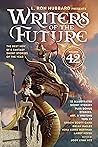
Book Review: Writers of the Future, Volume 41

L. Ron Hubbard Presents Writers of the Future, Volume 41L. Ron Hubbard Presents Writers of the Future, Volume 41 by L. Ron Hubbard
My rating: 4 of 5 stars

Another great anthology of upcoming SFF writers and illustrators!
I enjoyed all the stories in this one, though nothing really stood out to me this round.

Quite a few focused on time travel and time skips - and heavier on the scifi - which could be a reason why. "Storm Damage" by T.R. Naus was easy enough to follow but "Blackbird Stone" by Ian Keith, however, kind of did me in. lol.

Peeling back genre trappings, each story seems to be interrogating human behaviour. "Storm Damage" tests if the keeper of time travel will be able to put public good and the safety of the world above personal glory. "Ascii" by Randyn C.J. Bartholomew considers whether killing one man to save the future is justified. "Karma Birds" by Lauren McGuire envisions a dystopic world where violence is met with instant karma, whilst "The Rune Witch" by Jefferson Snow has Jindei standing alone between the villagers and the demon Shijai.

If I were to pick my top three stories, I think the ones that I enjoyed the most were "The Stench of Freedom" (Joel C. Scoberg), "The Rune Witch (Jefferson Snow), and "A World of Repetitions" (Seth Atwater Jr.

Note: I received a digital ARC of this book from Galaxy Press via Edelweiss. Opinions expressed in this review are completely my own.

View all my reviews
PURCHASE HERE (Amazon Affiliate link)