
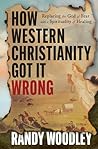
 How Western Christianity Got It Wrong: Replacing the God of Fear with a Spirituality of Healing by Randy Woodley
My rating: 5 of 5 stars
How Western Christianity Got It Wrong: Replacing the God of Fear with a Spirituality of Healing is a very thought-provoking book, as you can tell from the very title itself. No one wants to hear that the way their religion is practiced is (almost) completely wrong, but sometimes it's what you need to hear.
I picked up this ARC from Edelweiss because I've been facing a dissonance for a while now between how Christianity is commonly practiced globally vs my understanding of Scripture (and the whole but What Would Jesus Do! thing) and I wanted to see what Woodley had to say. There are some bold statements in the book (especially re: Jesus' purpose with regards to religion) that would probably require further thought, but on the whole, Woodley's explanations on church history and how Western Christianity got to where it is today is eye-opening and resonates with a lot of things I've been working through (and that's been coming out of the woodwork with the whole MAGA thing). It's also very accessible reading, even whilst being heavy on historical details - so it feels both solid and in depth without turning into some academic slog.
One thing I am ambivalent about - and Woodley does address it briefly - is that reinterpreting Scripture through his Indigenous lens does at times feel a little like syncretism. Which, on one hand, is what Western Christianity has totally done through out history (while wiping out other cultures), so it probably balances back out somewhat. Part of it could just be verbiage, and how Woodley expresses himself, which feels jarring to me tonally. This is one of the things I think would work for his community - and indigenous groups specifically - but not for a large majority of urban and mostly displaced and/or already culturally-disconnected Christians.
Yet, looking at the examples given, what it really highlights is the fact that all cultures and all tribes have the knowledge of God hidden in their histories and understanding of the world - it's a matter of looking at them and seeing where they align with the Bible, even if the symbols used are something completely different.
Chapter 11: How We Recover from Western Christianity is where things get a little muddy for me. This chapter is very heavy on repatriations from White churches to Native American communities, and is very rooted in the American context. I understand that Woodley can only write from his context, but it's very weird to have, in the midst of how community is strength, and how we need unity and diversity, caveats about cultural appropriation. It also sometimes feels like there's a need to punish the current generation for the sins of the past. How that looks like in Malaysia is vastly different, so a lot of the examples in chapter are not directly applicable except in the broadest terms when reading this from a Malaysian context
But, as he points out, any movement forward must be "place-based, rooted in the specific lands, histories, and cultural contexts that shape community needs, rather than imposing one-size-fits-all solutions that ignore local Indigenous wisdom." This is something I'll need to contemplate on further.
Overall, I think this book is important reading to understand what has shaped the current church, no matter where you are based, especially since a lot of Asian/Southeast Asian churches are heavily influenced by American churches through their former missionary work and mass media.
Note: I received a digital ARC of this book from Broadleaf Books via Edelweiss. Opinions expressed in this review are completely my own.
View all my reviews
Interested in reading? PREORDER NOW (Affiliate link)


No comments:
Post a Comment