Showing posts with label ownvoices. Show all posts

Wednesday, 7 May 2025

Book Review: OBJECTS OF DESIRE: 10 Malaysian Chinese Short Stories in Translation

OBJECTS OF DESIRE: 10 Malaysian Chinese Short Stories in TranslationOBJECTS OF DESIRE: 10 Malaysian Chinese Short Stories in Translation by Lee Hao Jie


Interesting things I have learnt about Mahua, which I think is different from English lit:
- naming the main protagonist is, apparently, almost unheard of. OMG like 8/10 stories do not name the MC and sometimes not even the other characters T.T And one of them, I'm not actually sure if the MC was named or not, so maybe that's 9/10 lmaoooo
- the writers reference English classics, which is interesting, because I wouldn't expect any English works to reference Chinese lit!
- there are a lot of stories around memories and losing the past. Maybe this is an outflow of how Malaysian Chinese feel like we're slowly losing our culture to time and modernisation.
- also a lot of family feels.
- maybe also a preoccupation with death... idk, I feel like only 2 stories don't mention death (or a dead person) in any form.

How Mahua is similar to English literary short stories:
- the writers have an obsession with affairs, sex, and the penis. 
- some of them have really weird endings? Like what? What am I supposed to get from this? Is this story even complete? IS THIS A FEVER DREAM.
- these are the same reasons I rarely read (or write) in the "literary" genre lol.

Anyway, notable stories, or stories I thought were really strong:
Xia Mei’s Clock by King Ban Hui, Yee Heng Yeh (Tr)
This is the story where the title comes from:
“At one point, he had swiped through the photos of these girls who, through the way they dressed, presented themselves as objects of desire on the website. Whoever they once were had been reduced to just their name, age, body measurements, and nationality.”

Xia Mei’s Clock is a pandemic story, where interpersonal connections are fraying and time has lost its meaning. The protagonist (also unnamed, unless that stray mention of ‘Xing Ye’ towards the end is his name?) requests for a human prostitute at the clock hotel instead of a silicone doll. Yet as the story slips from the protagonist, to Xia Mei, then back again; and as COVID rages and time skips; there’s an underlying surrealness to the story, making you question if Xia Mei is actually human.
As much as I thought this was a really iffy premise, this is a solid story on connection, the male loneliness epidemic, and the ravages of time.

Our Years on the Mountain Top by Tew Pak Ching, Lai Suk Yin (Tr)
If I had to make a snap judgement on Mahua based on this book, it would be the fact that Malaysian Chinese writers are somehow obsessed with penises. This heartwarming story of sibling love (and rivalry) as well as a mother’s sacrifice for her children (both evident in the mother and grandmother in this story) is framed by the very strange peeing competition in the morning, and the younger sister’s preoccupation for looking at her brother’s pee-pee. Like why.

Yesterday’s Sunken Fragrance by Chan Yeong Siew, Foo Sek Han (Tr)
A chance look at a Malaysian news headline reveals the truth behind the long silence from Liu Chen Xiang’s lover, Ma Yao Han.
Actually, the most exciting thing about this story is that finally, finally EVERYONE IS NAMED. It’s a weird thing to note, because like a predominant writing advice in English is to name your characters upfront and all these stories so far have gotten away with having a lot of unnamed characters. But I digress.
Yesterday’s Sunken Fragrance dwells in memories and loss, and also secrets and the grief that comes from them. It’s bittersweet, and yet also tinged with practicality as Chen Xiang says her goodbyes in the city she’s long left behind.

Panas by leemuzmuz, Ooi Yining (Tr)
Panas is a hard-hitting story of sexual assault in school, flitting from her present trauma to the past events that created them. It’s a painful look at how the perpetrators are often protected and victims told to just suck it up and move on. And that last haunting question: would none of this have happened if she were a boy?

All in all, this was a fascinating exploration of literature that I would normally never read, either because of the genre or because of the language.

Looking forward to the next in the series!

View all my reviews

---

Wanna grab your own copy? It's available on Amazon! (Affiliate link)

Wednesday, 22 January 2025

Book Review: A Stitch in Time | Lee Su Ann

A Stitch in TimeA Stitch in Time by Lee Su Ann
My rating: 4 of 5 stars

A Stitch in Time is a pretty lighthearted read.

Gavin Lai presents as something of a ghost through most of the book, but he's not a scary ghost - just a self-absorbed young actor trying to get back into the real world.

Clare Chong, a super quiet, introverted girl, is the only one in the school who can see him. Which means she's the only one who can help him. She has to confront her fears and inadequacies in order to solve the mystery of his disappearance... while he has to face himself and what has brought him to this place.

90s pop culture references abound, which makes it fun (and maybe a little nostalgic) to read as one who grew up in those times. I'm not sure if present day YA (ie the real target readers) would find that as exciting, or just incomprehensible. I mean, they're still using FAXES and DIAL-UP internet, and there are no smartphones! Only old-fashioned, large, bulky mobile phones that only business men use...

View all my reviews

Wednesday, 4 September 2024

#bookreview: The Friend Zone Experiment | Zen Cho

The Friend Zone ExperimentThe Friend Zone Experiment by Zen Cho

Renee Goh is a successful businesswoman blazing her own trail in London, away from her patriarchal Singaporean family. Then her father offers Renee the one thing she's been hankering after: approval in the form of offering her the chance to take over the family business. But is that what she really wants? (Insert break-up drama, family feuds, old-flame reunion, plus that one skeevy ex.)

I'm trying to figure out what I feel about this one. I do quite like Zen Cho's fantasy works - and I especially love the Malaysiana she brings into her stories. She's especially deft at capturing the Malaysian Auntie Voice.

The usual "not quite my genre, bla bla" comments apply here. This is straight up realistic fiction, not a ghost or supernatural creature in sight! The style feels like a throwback to her earlier short story style, not so much her long-form fantasy style. (I haven't gotten round to Black Water Sister, which may have been the beginnings of the shift?) This isn't a bad thing. I do like that voice and I want to see more of it in fiction. However, I don't think I've read a romance (as the main plot) in a while (if I have ever! haha), so there were bits that felt a little draggy here and there, especially where everyone's keeping secrets and not telling anyone important stuff. Then again, that's also the bits I get annoyed with in all kinds media and without which there would be no story, so, eh.

MAYBE what's throwing me off is the whole, uh, sub-plot that it's wrapped around. It hits very close to real-life happenings in Malaysia. Maybe someone who isn't based here would just read it as fiction (I'm seeing a lot of K-drama references in other reviews) but I'm also going like OH THE SARAWAK REPORT. OH CLARE REWCASTLE-BROWN. OH 1MDB! ALL THE ILLEGAL LOGGING. OBVIOUSLY THEY KIDNAPPED AND KILLED HIM WHAT DID YOU THINK. Which also makes me wonder whether the stuff we read as fiction from other countries hits as hard for their readers in the same way.

Cho brings up the Malaysian/Singaporean family dynamics really, really well - which adds to the ultra-realism of this novel. The family squabbles! The expectations of marriage (and grandchildren)! The fight over who pays for dinner! All that annoying one-upmanship... ugh. Though I can't help but feel that Ket Siong is something of a wish-fulfilment fantasy - he's a little too good to be true.

There's also a lot of corporate drama (and some sexual harassment) going on, plus a heavy dose of family loyalty vs ethics considerations. Do you keep the peace in order to save your family's face/reputation? Do you let yourself love the person whose family has destroyed your own? CAN you put aside your own personal boundaries if that's going to help your family business?

It isn't quite a light read (despite "romcom" being thrown around), but it does have a Happily Ever After. I don't know the genre well enough to say if it'll be a hit for romance readers, but I'd say it's a solid rep of how Malaysian society works (even displaced as they are in London) if you're looking for that.

Note: I received a digital ARC of this book from Pan Macmillan via NetGalley. Opinions expressed in this review are completely my own.

View all my reviews

---

If you're looking for a GREAT Zen Cho book to start with, I'll always recommend The Order of the Pure Moon Reflected in Water. (Get it here)

Wednesday, 13 March 2024

Book Review: Say Hello to My Little Friend | Jennine Capó Crucet

Say Hello to My Little FriendSay Hello to My Little Friend by Jennine Capo Crucet
My rating: 4 of 5 stars

I'd put this at about 3.5 stars, to balance out personal enjoyment and more writing/research needs.

Right. So I picked this up from Edelweiss because I've been looking at ways different people write about their own experiences and places in fiction. Call it semi-research. The description sounded interesting enough, so why not?

Personally, I kind of got a little bored midway through because Izzy is dumb (Though, if he isn't, where's the story?) and Lolita... well, the orca never gets anywhere. It meanders a lot in a way that doesn't really interest me; it's not a plot or type of book I'd normally be raring to read. The ending was weird (what's with the letter? lol), but what caught me was the bit before the end. The resolution for Izzy's search for his past, the repressed memories, the way it all unfolds. Also, it's very magical realism in the sense that you never quite know what's real or not at some places.

But as a study in voice and in not pandering to monolithic, imagined white reader, I love it. I may not understand all the Spanish (?) that punctuates the narrative and the dialogue, but it holds the attention, it captures me, it makes me want to know more. Though I'll do without the iguanas and alligators.

In conclusion, if you're Cuban-American this might resonate with you more. Or, I guess, if you live in Miami.

Note: I received a digital ARC of this book from Simon & Schuster via Edelweiss. Opinions expressed in this review are completely my own.

View all my reviews

Purchase on Amazon (affiliate link) 

Wednesday, 11 October 2023

#bookreview: The Blue Monsoon | Damyanti Biswas

The Blue Monsoon (Blue Mumbai, #2)The Blue Monsoon by Damyanti Biswas
My rating: 4 of 5 stars

I took a while to write this review because I've been having a tough time trying to reconcile my feelings about The Blue Monsoon. Where The Blue Bar was gripping and easy to love, ending on quite a hopeful note, this one picks up again two years later on a somewhat dreary note. And as the rains and flooding in Mumbai threaten Arnav's case, so does the dreariness sometimes overwhelm the reader.

When I say dreary, I don't mean that the story is slow in any way. It's quite as gripping as The
Blue Bar
, maybe even more so because we already know, and are invested in, the main characters. In this one, Arnav is faced by how much he doesn't perceive or understand because he is a high caste man in Indian society; Tara is struggling with her lack of independence due to her high-risk pregnancy and injury; Sita is just trying to do her job without complicated relationships; and in the midst of it all, the deaths--dismembered men with tantric symbols carved in flesh--and threats keep coming. Links to influencers and hopeful politicians again push these cases into the limelight... and maybe there's a point where Arnav's weariness seeps through the narrative and makes everything feel too much, too bleak.

In many ways, The Blue Monsoon is a critique on the lingering caste system in India; but more than that, it attempts to show how privilege blinds one to injustices, how affirmative action policies don't quite solve anything (and sometimes makes them worse), and how gender (or rather, being female) exacerbates everything. It's not an easy read by any means, but then again, none of Biswas's books are.

Overall, the Blue Monsoon is a dark, gritty, crime procedural/thriller and probably should come with some trigger warnings. (Some gore, including castration; sexual abuse and harassment; difficult pregnancies; discrimination/slurs against transwomen)

Note: I received a digital ARC of this book from Thomas & Mercer via NetGalley. Opinions expressed in this review are completely my own.

View all my reviews


Monday, 3 July 2023

Join the #MalaysianMagic launch team!

 New book, new tour!


This one's an anthology that I really loved putting together. IT'S AMAZING, PEOPLE! Even if I have to say so myself *ahem*

Anyways, join the launch fun! Cover reveal's in about 2 weeks and the launch is in November at GTLF! Again! We have rough dates of between 23 - 26 November, which are the festival dates, but don't know the exact day/time yet.

But ebooks launch 23 November anyway. 

HERE'S THE SIGN-UP FORM. COME SHARE SHARE THIS BOOOOOOOK.


Wednesday, 7 December 2022

#bookreview: Ripples and Other Stories | Shih-Li Kow

Ripples and Other StoriesRipples and Other Stories by Shih-Li Kow
My rating: 4 of 5 stars

It's hard to say what I really think of this.

On one hand, I'm not a huge fan of this kind of writing. By themselves, each short story seems to be a rather banal slice of life that doesn't quite lead anywhere. There's some drama in a few of them, but in a majority of the stories, it's just a thing that happened, something that's being told; there's no inherent conflict, no quick emotional hit that we tend to look for in a short story. This thing happened, so-and-so said something, the end.

And yet, there is a certain something about the way Kow weaves the compilation together, centred around a few key characters and their families. Each person's actions, each person's story creates ripples that affect the next. The POVs shift, identities are sometimes unclear. Despite the utter normalcy and banality, there's a lingering mystery that draws the reader to want to go back and read it again to figure out where the interconnections are made, where the ripples were formed and how far they stretched. Did this thing referenced in this story really...? Is this the same person that...?

The language is fluid and beautiful; it's not the stiltedly polished English we tend to get in Malaysian literature (can you tell I'm jaded yet?). Instead, it's a true reflection of our tongues and inflections, the mix of languages that make up our everyday lives.

Ripples and Other Stories is unapologetically Malaysian in setting and in tone and definitely deserves a closer read.

View all my reviews

 ---

Ripples doesn't seem to be in print anymore, but you can get it as an ebook via Pakka English/Silverfish Books

Wednesday, 31 August 2022

#netgalley #bookreview: The Blue Bar | Damyanti Biswas

The Blue BarThe Blue Bar by Damyanti Biswas
My rating: 5 of 5 stars

The discovery of a dead body on real estate tycoon Rahul Taneja's lands sets Inspector Arnav Singh Rajput on a trail that may not only uncover a serial killer, but also dig up things in his own past that he's long since buried. Like his dead sister, who he's still trying to find justice for. Or Tara, his once-girlfriend, who vanished without a word. But the path to solving this case is blocked by rich men with friends in high places, corruption at the highest levels of government, and complications from two warring Mumbai gangs.

Biswas drops you into the heat of things in Mumbai, immersing you in a gritty world that is unlike the usual crime thriller settings in the UK or USA. In her words, you can almost feel the push and pull of the crowds gathering for Dussehra and Diwali and hear the street vendors offering bhelpuri and pao bhaji. She adds authenticity with the use of local terms, often following them up with a deft explanation, expecting you to remember it from then on.

Each chapter is told from a different POV--most of it Arnav and Tara, though occasionally we hear from the unsub and his assistant Bilal. In Arnav's voice, you hear his frustration and conflict, in Tara's, you feel her tenacity and her fear. It's the unsub's voice that is chilling in its depravity, callousness and anger--and when the final reveal comes, you're left reeling, like how...? and yet how inevitable.

Like in You Beneath Your Skin, Biswas is not afraid to show the seedier parts of India, highlighting the way women are often disregarded and their lives treated as nothing but "packages" and "item numbers". She shows the horrifying requests men make of women who have no other options, but she also shows the horrible things women can do to young, naive boys in their power.

The Blue Bar is very much a story of powerlessness, whether is Arnav against the serial killer and the corruption in the police force; or Tara against the seedy men who are out to destroy the life she's managed to build for herself; or the unsub against his tormentor, but it is also about choice and risk, and taking responsibility for those choices.

Where in many crime thrillers, you watch as jaded protagonists' lives are falling apart, in this one, Arnav is faced with a second chance at family and happiness. Will he take it?

Note: I received a digital ARC of this book from Thomas & Mercer via Netgalley. Opinions expressed in this review are completely my own.

View all my reviews

Wednesday, 24 August 2022

#netgalley #bookreview: The Very Secret Society of Irregular Witches | Sangu Mandanna

The Very Secret Society of Irregular WitchesThe Very Secret Society of Irregular Witches by Sangu Mandanna
My rating: 5 of 5 stars

Secrets can protect you. But they can also hurt you.

In an alternate Britain where anti-magic sentiments are high and a misfired spell has resulted in all magical children becoming orphans, Mika Moon has only known isolation and mistrust. She doesn't create strong ties and she definitely does not put down roots. But when a strange message on her social media account lures her to the mysterious Nowhere House, Mika has to decide if she should leave and report them to Primrose, ultimately separating three young children (and letting them grow up miserable under the very same Rules she's always hated)...or if she should stay and teach the three young witches how to control their magic (and maybe give them a sense of belonging and a semblance of a normal life).

The Very Secret Society of Irregular Witches is a beautiful story of belonging, acceptance, and found family. The longer Mika stays, the more she realises that maybe the way she was brought up wasn't quite right, even if the strict rules were put in place for her protection. The strange assortment of adults in the house - a retired actor and his gardener husband, a long-suffering housekeeper and a prickly librarian - soon show her what it means to live in community and love each other sacrificially, even when they're at odds with each other. It makes her want to finally set down roots - especially with that hot, prickly librarian who is oddly spending a lot of time with her.

In that light, I suppose you can also read the story as a fantasy romance - with all the predictability that that involves: secrets kept, revelations that come just a little too late, a betrayal of trust. Can Mika and Jamie truly trust each other when the starting point of their relationship was built upon a web of lies? Secrets are costly, but they're not the only ones keeping them. (I did somewhat see that twist coming.)

Overall, the book is a funny and heart-warming read, though not exactly clean. There is quite a bit of swearing and a sex scene somewhere in Chapter 26 - so despite its overall feel-good nature, not exactly one for younger readers.

Note: I received a digital ARC of this book from Hodder & Stoughton via NetGalley. Opinions expressed in this review are completely my own.

View all my reviews

Thursday, 11 August 2022

Inclusion and Diversity: A Rant

I have been struggling about whether to write about this but the anger and the bitterness are taking up too much space in my head, so maybe if it's written down in some form or other it will go away and leave me alone. For now. 

General life advice: never read the comments. Never, ever read the comments.

Even if they're on a post in a Facebook group that is, ostensibly, meant for...discussion. But what you don't read won't hurt you. And what you don't see won't send you into incandescent rage.

ANYWAY, this post is basically a response to a specific thread in a specific group, but I figured it's also a somewhat writing-related post which may (or may not, whatever) be helpful to people trying to navigate this whole thing around inclusion and diversity in fiction. I have been stewing over this since 29 July, so it's obviously not something I am about to just let go. I do not want to actually respond in the thread lest I BLOW UP AND RAGE QUIT. (I kind of like the other stuff that happens in the group so I'm trying not to rage quit at this point. Also, the admins and the founders have been kind and diplomatic and civil so I may just end up blocking a couple of people instead.) I also do not have the mental energy for arguing; my preferred method for dealing with confrontation is to walk. away. 

(But I am also passive-aggressive, hence this post.)

Note: It's been more than a week since I started writing this, the thread is quiet but reading it still leads to mild annoyance, so I suppose I will just finish the post. 

---

This whole kerfuffle started because someone had the audacity to say that adaptations to literature that make it more inclusive are a good thing

Which is, apparently, NOT the thing to say because all fantasy canon is holy and cannot be changed. (/s in case you weren't sure.)

Now, I'm not a very good fangirl. I find a lot of fannish things a little over the top and a bit too cultish at times. Example: I like LOTR but don't ask me to quote paragraphs for you. I'll probably never dress up like a hobbit, though we do joke that Penangites eat like hobbits. I do agree with many of the (other) comments that some recent adaptations *cough* The Hobbit *cough* were badly done because none of the additions made narrative sense. Yet...the most I'd do in response is go re-read the book and just never watch the movies ever again. I'm not a huge movie/series person anyway, so I'm probably not even going to watch The Thing they are obliquely complaining about. I'd also rather people write new stories with diverse characters and settings rather than remake old ones which are gender/race bent (sometimes the changes work, sometimes it's just...but why?) which is what many of them are pushing for. 

So, if I agree with so many of their talking points, why am I so bugged by the whole conversation? Because of the sense of entitlement and the overall tone of complaint that implies that Changing Anything In A Story By Adding Diversity Is A Personal Affront And An Attack On Me. 

I was going to post a bunch of quotes verbatim and address them, but for the sake of length and privacy, I'll just summarise their main points.


Changing the race of my favourite character steals something from me. Also, it's always a one-way thing; shows with predominantly POC characters are never rewritten to include/feature white people. 

I can't even begin to address the entitlement on this one. It's all "me! me! me!" here. How dare anyone make a story that's not meant for me?! How dare you make a story about someone else and not include someone like me?! /s 

There are many things in this world that are not made specifically for you, and that's okay! The original show still exists. You can go rewatch the original show and ignore the new one. Also, the point of this whole inclusion and diversity drive is to include people who have been historically erased from fiction (whether in books or on-screen), so reversing it to include MORE of the people who have millions of shows that reflect them...does not serve any purpose at all. 


We can learn to identify with themes in a story even if the characters don't look like us. 

Which is true! However, the commenter doubled down along the lines of "if I as a White Man can identify and learn from stories of other cultures, then POC don't need characters to look like them". Kudos for doing what we have always done. This totally ignores the fact that for many, many years, centuries even, everyone reading in English, of whatever race and ethnicity, has had to learn to identify with the White person and learn from their culture, so maybe it's time that we do not have to? That maybe, for once, it's nice to see a story we already love have people in it that look like us? To be fair, this was already addressed in the thread. It's just still annoying. 


Trying to make something that is for everybody cuts out diversity because some things just aren't relatable to some people.

First, nobody is trying to make something that is for everybody. They're just looking at a thing and going "hey look, the real world has a bunch of people with different skin colours living in the same place, plus a whole lot of people from different countries around the world enjoy this thing, so maybe this fantasy world should also have a bunch of different-looking people living in the same place". And if that makes a wider, more diverse pool of fans happy, that's what they want, isn't it? More people all around the world watching a show or reading a thing (and giving them more money)?

Second, I do not understand how that "cuts down the diversity". If the thing isn't relatable to you, just don't consume it. It doesn't mean that people should stop making it. I think that's a thing everyone else has already learnt. 


Making someone have a different skin color or gender doesn't make it more inclusive. My (white) sub-culture is rarely depicted well, yet I don't need a white woman to show up to enjoy the story. 

Great for you. If that's the case, then why are you so upset that someone Not White gets to be included in a story? I mean, we're not saying that we don't enjoy those stories either. In fact I'd say that sometimes we enjoy it so much that we (a general, inclusive we) would like to make adaptations of the thing so that other people who look like us can enjoy it even more!

But I'd like to reiterate that someone representing rural or homeschool culture wrong (which is a choice in most cases and something that you can change by say moving to a city or joining a public school) is different from someone representing your race with bad stereotypes (which is something you cannot change at all even if you moved across the world and had plastic surgery or skin grafts or whatever).

At any rate, I suppose this is a great segue into Personal Story Time. 

---

When I was a kid, we used to have these colouring books. I don't remember if they were princesses or fairies or whatever, but well, pretty girls in pretty dresses. And I was looking back at them one day (before throwing them out) and realised that the majority of the girls I coloured had blue eyes and blond hair. Which is weird because I'm 100% ethnically Chinese, living in Malaysia which is in Southeast Asia, an area that has a very minuscule percentage of blue-eyed, blond-haired people. 

When I started writing, I would hardly ever describe my characters. I'd use very vague, ambiguous urban settings so that they could be set in any large city around the world. Everyone would have an English name. I don't know exactly why. Part of it was this feeling of not wanting to set it somewhere local because it was...weird (shameful, maybe?) and boring. But I also didn't know where to set those stories - I didn't know enough about some random place in some foreign country to set it there (this was before the Internet was a Thing). Okay, I know why I did the name thing: it's easier to search a baby book for an English name than to create Chinese names, especially since I don't know Chinese.

Later on, I realised another thing. I could write short stories with Asian people in real life settings, but every time I started writing a fantasy story, almost all my characters would end up white or white-ish. Why? Because all the fantasy books I read growing up featured very eurocentric settings and characters. Fantasy was obviously a White People thing, Chinese people could not feature in them. It wasn't that I consciously thought this out - it was just there. In the back of my mind. Affecting all my creative decisions. I wrote about that in this guest post - how I had to deliberately make a shift in my head to base Amok in a Southeast Asian setting, instead of that "white default".

There was a related comment on the thread (that I can't find anymore) which stated something to the effect that if there are 6 white people in the show and one of them is changed to another race, but all of them think the same, that's still not diversity because they all...think the same. 

...and I'm like, I'm not sure you're even talking about the same thing that the rest of us are talking about anymore. (But maybe I'm misremembering it.)

But to kid me, if there were 5 white people and 1 Chinese person in a fantasy show or book, I would probably have had an earlier epiphany about my creative choices, even if it was just colouring that princess with brown eyes and black hair.

(I have thoughts about what diversity is, plus how second- & third-generation immigrants are usually closer to the culture of their country of residence than their culture of origin under the section "But what is diversity?" in this article.)

---

Someone reposted this on Facebook the other day, and I feel like this encapsulates this whole argument and why it's so grating.
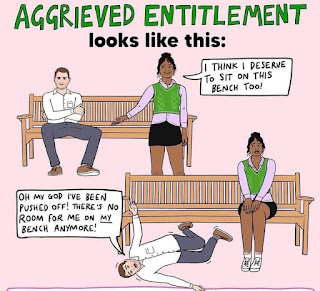
Source: https://twitter.com/vulgadrawings

What I really think is that y'all are just being super entitled, like the world has to revolve around you and what you want or what you think is "good" and "right". If I can put it in somewhat literary terms, you're acting like Dudley Dursley when he throws a tantrum because he had one less birthday present than the year before. 

Racism was somehow also brought up (I don't remember the exact context because those comments have apparently been deleted), so I might as well just address it because, for some people, just saying that "you really need to rethink this stance on inclusion" equals calling them racist. 

Do I necessarily think you're racist because you don't want diversity added to your beloved canons? No, though that really depends on why you are against it. (And usually how you phrase it.)

If it's for Story Reasons (e.g. the background/backstory doesn't make sense anymore, how did 2 white humans have a child of a different race without magic or IVF or gene manipulation or adoption or maybe plain adultery)... you know what? I'd likely agree with you that that specific effort was bad. The worldbuilding has to make sense, the narrative needs to be internally consistent. Sometimes people try to change things, but they don't go backwards into the history/lore quite enough. Good try, but I guess it didn't quite work out. 

But if your only objection is It Was Originally Written White So Changing it is Pandering To The Woke Crowd... or History! There Were No [Race] In History (when it's totally fictional, fantasy world)...

Let's just put it this way: the way some of you say that "inclusion and diversity is virtue signalling" tells me that really, you don't think I am a person. That I cannot exist except on your terms, when you want me to (probably when you need that token Not-White friend). That putting someone who looks like me into a fantasy story will always only be a political move. And not just a reflection of hey, the real world is made up of a bunch of different looking people, my fantasy world is going to be made up of a bunch of different looking people. 

You're telling me that I am a virtue signal and that don't deserve to have a story written for people like me. And that hurts. (Don't bother defending yourselves. It's okay really. I don't need to be your friend. You don't need to be mine.)

All that? Yes, that is racist. Even if you don't mean it to be. 

---

And since the group it was posted in is a Christian group, I feel like there's even more that should be addressed. 

First, I'd like to add that if you're complaining about not seeing Christians in fiction anymore or how Christians are always being portrayed as the "bad guy", think about how POC feel when there are SOOOO many books that do not have any POC, or if they are portrayed at all, are only ever the "bad guy" or the "comic sidekick" (with "comic" usually meaning slow, dumb, or useless).

But most of all, I suppose this is my specific gripe with White Christianity as a whole: that most times, when unity is sought, it’s taken to mean that one needs to conform to the traditions of the western church. In parallel, it’s like the Jews in Acts 15 insisting the Gentiles be circumcised, according to the custom taught by Moses, to be saved - forgetting that Peter addressed the apostles and the elders thus:

Brothers, you know that some time ago God made a choice among you that the Gentiles might hear from my lips the message of the gospel and believe. God, who knows the heart, showed that he accepted them by giving the Holy Spirit to them, just as he did to us. He did not discriminate between us and them, for he purified their hearts by faith. Now then, why do you try to test God by putting on the necks of the Gentiles a yoke that neither we nor our ancestors have been able to bear? No! We believe it is through the grace of our Lord Jesus that we are saved, just as they are.” — Acts 15: 7b-11 (NIV)

I wrote about this before here, so I'll not repeat the whole thing again.

But this insistence on Whiteness in a Christian group makes me wonder sometimes if we are truly following Jesus or if we are just following the White Man.

---

Anyway, Inclusion and Diversity. 

You know how they tell artists & writers to push through? That you have to get through the bad art and the terrible first drafts (or first dozen manuscripts) to get to the good stuff? That working through the bad takes is what will help you hone your craft? That right there is inclusion and diversity in the market right now.

People have realised a bias and a gap in the market, and they're talking about it. They've created such a buzz that the big publishers (and media companies) have taken notice. So they're pushing all of that out into the market right now, trying to ride on the wave. They're also probably overcorrecting or overcompensating to some extent - but then there's a huge structural bias to push against so that's probably why.

There's no doubt that some of this push is political - and companies wanting clout. That's okay. That's natural. But I think a lot of it is just people wanting to see their everyday lives (and faces) reflected in the media around them. So they're creating new stories (which often don't sell because saturated market) and also adapting old ones (which make a buzz because existing fanbase, many eyes, much money). 

Do they always get it right? No. Is that a bad thing? Also no. 

Does this change or somehow devalue the "classics" they were based on? No. Because those books/shows are still there

Do I necessarily want (or need) another old story rewritten with the White Male Protagonist changed into a Chinese Female Protagonist? Probably not. Because I've already worked through a lot of this for myself. And it doesn't quite affect me as an adult anymore. 

But you know, there are plenty of kids out there seeing all this stuff for the first time. And if this remake with Black Ariel or She-Hulk or Female Thor or racially-diverse dwarves (I don't even know what the objection is, actually) is what's going to give them that epiphany earlier in their lives, we probably would get through all the bad takes faster to reach the better, original, diverse fiction earlier. Because they would be starting at the place I took maybe 20 years to get to. 

At any rate, siapa yang makan cili, dia terasa pedasnya.

Wednesday, 27 July 2022

#bookreview: The Monk Prince | Golda Mowe

The Monk PrinceThe Monk Prince by Golda Mowe
My rating: 3 of 5 stars

I've been sitting on this review, mostly because I do not know how to write it. I was rather ambivalent about Golda Mowe's first novel, Iban Dream, which was published by Monsoon Books. (I do not like most of Monsoon Books' list, so make of that what you will.) But I did quite like The Nanobots and Other Stories, so I figured I would give this one a try since it was published by Penguin SEA.

Ok look. Just because a book is published by Penguin Random House SEA doesn't mean it's good. I'm beginning to side-eye Penguin SEA and their poor editing quality (all outsourced!), strange cover decisions, and stupid pricing. I probably wouldn't be as annoyed with this book if it had cost the usual RM50 (-ish) for imported books instead of a whopping RM75. I'm not half as mad that I didn't quite like another local book I really should be reviewing because that only cost like RM20 (-ish. Can't remember what I paid for shipping). Printing in Singapore expensive kut.

ANYWAY. Back to the book itself.

The Monk Prince is an epic royal saga set in the Malay Archipelago in the 600s. Parantapa, raised by Buddhist monks to non-violence, is thrust abruptly into the middle of family drama when King Wayulo's spies finally find him after twenty years of searching. Not only does he have to adjust from a life of abstinence to one of plenty, he also finds himself an unwilling contender for the throne when King Wayulo discovers that his firstborn, Prince Alak Tegoh, isn't actually his biological son - meaning that Parantapa also has to give up his life of non-violence and learn to protect himself and his people. Across the sea, King Wayulo's brother-in-law, King Jayagapor, is looking to expand his political influence and increase his lands - and creating a war to put his nephew on Wayulo's throne looks like the perfect way to do it.

Filled with murder, betrayal, spies, and sea battles, The Monk Prince should have made for an enthralling read. However, the writing style creates an awkward distance between the reader and the story, leaving me feeling like I'm an observer from afar, rather than being able to immerse myself in the story world. In a way, it feels like actors merely reading lines instead of acting out and emoting the scenes. I suppose this is a preference rather than a fault.

There's also a slight feeling of disjointedness between scenes, as if the transitions are not quite right. This was especially obvious in later chapters when the scenes flip between POVs and the timeline becomes fuzzy. Does this next scene happen after the earlier one? Or are they overlapping? Why are we suddenly head-hopping so much?

For a book published by a major publishing house, it felt like the prose could have been polished much more. It starts off well, sags and drags a little in the middle, then picks up again with a lot of drama and action towards the end. There were also a few rather obvious typos, but well, typos happen. What irked me the most (maybe because I have struggled with this before) is the inconsistency in the titles & terms used. Within the same paragraph, Mowe switches between princess and puteri for Ming Zhu and between raja and king for Wayulo. Sometimes Megabintang is Queen, sometimes she is Rani. Gunawan is Commander in one line, then Panglima in the next. I think I fault the editor for this one.

As I said at the start, experience tells me that I may not really like Mowe's writing style, and The Monk Prince seems to confirm that. The story itself is solid, reminiscent of Udayasankar's Three. Despite my ambivalence as a whole, I do think that this is a book worth investing your time in especially if you do like historical fiction a whole lot more than I do.

I'm still annoyed at the price, though.

View all my reviews

Thursday, 29 July 2021

#bookreview: Monkey Around | Jadie Jang

Monkey AroundMonkey Around by Jadie Jang
My rating: 5 of 5 stars

So, the great part about Monkey Around is that you don't need to be a Journey to the West kind of person to know what's going on! Though I suppose if you come with that kind of literary background you'd probably pick up things (clues? inside jokes?) that I might have missed. But not knowing is also cool and doesn't detract from the story as a whole, because you're taken on a journey of discovery with Maya herself!

Maya MacQueen is on a journey of discovering what she truly is - is she just a were-monkey, or is she something more? What lies behind the supercool powers she has that Ayo, magic-human-boss, doesn't seem to recognise? But in the midst of protesting at Occupy, barista-ing at Cafe Sanc-ahh, and taking on odd jobs for Ayo (like tracking down a missing aswang), supernatural creatures are turning up dead. Like Wayland Soh, the harimau jadian, and Bu-Bu, the bajang. And the only clue she has is that this soul-eating shadow is just like her.

What I love about Monkey Around is the wide range of cultures and supernatural creatures from all around the world that just appear, but is somehow still so rooted in place. Jang explores the many different were-creatures and magic users around the world that have migrated to (or pass through) the Bay, though two cultures are featured with some prominence - the Asian-American and Mexican (Mesoamerican?) communities.

With so many things going on, it feels like the disparate cultures and creatures should pull the story apart - or at least confuse it too much. Yet it doesn't. There's one thing that pulls them together, that provides a defining feature - the San Francisco Bay Area. The place feels like a character of its own. It speaks to Maya, it searches for its guardian. It's actively trying to save itself, and I love it. I also admit to having a soft spot for it in my heart due to the many times I once travelled there for work.

The most annoying thing about Monkey Around, though, is in my opinion, Maya. And that's actually a very personal thing. Okay, I should explain that a bit. Many readers gush about how much they *love* a character. I don't...fall in love with characters. There are very few characters that I super like, and that's also mostly because there are very few real people that I like. But there are very, very many characters that I hate, and that kind of correlates to the amount of real life people I just find annoying and tiresome and don't want to deal with. So back to the story, you know how you meet someone and they just...irritate you for no definable reason? Just one of those personalities that grates on you but everyone else is ok with (and maybe even like)? That's Maya for me. She's amusing to a point, until she protests "but the Monkey in me...." one too many times and [Anna stabs the Main Character].

At any rate, Monkey Around is a fun urban fantasy read that explores the diversity of the Bay, identity, and place.

Note: I received a digital ARC of this book via NetGalley. Opinions expressed in this review are completely my own.

View all my reviews

Wednesday, 4 November 2020

#bookreview: The Girl and the Ghost | Hanna Alkaf

The Girl and the GhostThe Girl and the Ghost by Hanna Alkaf
My rating: 4 of 5 stars

I don't quite know how to review this book.

On one hand, I enjoyed it--it is unabashedly Malaysian, it plays deeply on feelings of friendship and betrayal, loss and grief--yet, on the other hand, I put it down after the first half to go do something and I had no real desire to pick it up again to finish it off. And I really don't know why.

It's not the creepy/horror factor. However horrible or terrible the original creatures are (and are hinted to be), Pink doesn't stray too far from being just mischievous. Suraya's grandmother and the Pawang are people of power and who do nasty, evil things, but it's not described much in the book; it's MG, after all.

Maybe it's just because it's MG and I haven't read an MG book for a long time?

(It could just be my current reading mood; it probably IS just my current reading mood.)

Whatever it was, Suraya is the loner who finds a friend in the pelesit her grandmother bequeathed her. Then Jing comes into her life, and with this talkative new girl full of Star Wars references, a rift opens between Suraya and Pink. A story of friendship and bonds, light and dark, set against the backdrop of a Malaysian kampung and small-town life. Slight shades of Gaiman's The Graveyard Book towards the end, plus a super-touching ending.

View all my reviews

Wednesday, 1 July 2020

#bookreview: The SEA is Ours: Tales of Steampunk Southeast Asia

The Sea Is Ours: Tales from Steampunk Southeast AsiaThe Sea Is Ours: Tales from Steampunk Southeast Asia by Jaymee Goh
My rating: 3 of 5 stars

I suppose if I like half of an anthology, the anthology is a good one. I've been trying to find a way to review this more critically, but it just seems that I can't.

I suppose the dissonance comes from several things, the first of which primarily stems from the lack of steam in this version of steampunk. There's a quite a bit folklore/magic, sometimes used in combination with the technology; where it seems to grate (or at least confuse) are the bits where it seems to be substituted for the gears and clockwork. Either that or I'm not quite getting what they're trying to say.

The second is really a follow-on thought that a lot of SEAsian folklore tends towards horror and the macabre, which isn't what I enjoy reading. So whilst I enjoyed some of them, they turned out a little darker than I expected.

The stories almost all focus on a colonial past, on that space where history could have probably gone either way. This, I suppose, is already defined in the Introduction:
It was, and still is, imperative that we have volumes dedicated to our own voices, projects not of postcolonial melancholia, but decolonial determination. Our psyches cry for justice for lost names, lost stories, lost histories, all lost to globalized, systemic racism, lost to imperial dreams imposed upon us for too long. In the absence of time machines to recover them, we turn to re-creating, and creating anew. Thus, we use steampunk to have that conversation with our histories, our hearts and dreams.
I suppose i should end this updated review with some of the stories I enjoyed.

- The Last Aswang, Alessa Hinlo
-The Unmaking of the Cuadro Amoroso, Kate Osias
-Working Woman, Olivia Ho
-On the Consequence of Sound, Timothy Dimacali
-Spider Here, Robert Liow

View all my reviews

Friday, 30 August 2019

#Dublin2019 #AnIrishWorldCon in tweet threads

I was looking up my own notes for the panels I attended at Worldcon 2019, so here's a listing of the threads I made. Also so I can find it later on. lol. I dunno how this embedding thing works, I'm assuming you can click it to open the full thread.

We'll see.


Why did I attend so many panels. hahaha.

Thursday, 4 July 2019

Why Your England So Bad? World Englishes and the way forward for Malaysian writers

So. In the light of all the nasty debates over proper grammar and How English Standards Are Going Down The Drain in Malaysia, I figured I should post this online.

Now, to clarify, I used to be quite pedantic about my English and how perfect it has to be. It took reading a lot more local stuff that worked instead of the super-stilted Proper English Written by Malaysians (grammatically correct, but ugh) for me to figure out that no, actually...there is a rhythm and a beauty to the way we speak that actually makes sense. Malaysian English isn't quite standardised across races/states to be a proper creole, but there ARE rules to how we phrase things, which sometimes deviates a little depending on whether you're more influenced by Chinese, Malay, Tamil, or dll. Even pure bananas like me pick it up second-hand. And I don't speak any Chinese and my Malay is abysmal. haha.

It took me coming to study Creative Writing in London to figure this out. Who knew World Englishes is a Thing? They don't talk about it back home. BUT THEY SHOULD.

Anyway, I performed this at the The Decolonial Earth event in Goldsmiths, talking about my linguistic heritage. It starts with the monologue, titled 'Banana', and then continues with the rest of the essay.

DOWNLOAD MONOLOGUE

When I first started writing ‘Banana’, I had no idea what I wanted to say. It was something of a mishmash of thoughts and frustrations interspersed with some sort of a story. In a way, this monologue is a showcase of my ongoing confusion over who I’m supposed to be.

Technically, I know who I’m supposed to be. I’m ethnically Chinese, of Malaysian nationality. But it’s not quite that simple.

Like Karen, I often describe myself as a 100% Banana. Like, you would probably never find a less Chinese-speaking Chinese in Malaysia. And it’s a question I’ve been asked all through my life.

“Why don’t you speak Chinese?” 


I blame my father’s side of the family. (My dad is the one on the left.) My grandfather lost his parents to the Japanese occupation in Johor as a teen and my grandmother came to Malaysia alone also as a teen. Without family and community, both of them fell out of touch with their cultural heritage. They spoke Cantonese at home whilst living in Ipoh, but my dad 'forgot' how to speak Cantonese when he moved to Penang as a teen.

So, I grew up in an English-speaking Christian household (which means you don’t practice Chinese customs which are inherently Buddhist or Taoist) and attended a Sekolah Kebangsaan, or national school—but it was a Methodist school, which counted as “English-Ed”.


I lived in a very white-presenting bubble. Technically, we had all races—Malay, Chinese, Indian—but we spoke English to each other. And of course, enjoyed our banana leaf rice.

It wasn’t until I was in the US for a work thing that two things became very clear. For all I’m immersed in White culture, I’m too Asian to be White. Fair enough. And then I visited a Chinese-speaking church in San Jose and realised how un-Chinese I was, even though I was actually from and based in Asia.


Now, this is the hard thing—at least for me. If you are diaspora who grew up in Britain, or in Australia, or in North America, it’s easier to reconcile some of that dissonance. You’ve chosen the cultural affiliations associated with the country you or your parents migrated to.

I am very firmly rooted in Malaysia. What excuse do I have?

“Why don’t you speak Malay?”

This is where the bubble comes in—for all that the Chinese diaspora is so thoroughly Malaysian (and quite proud of it), it’s usually the food and celebrations that are highlighted. Not the language. Instead of Bahasa Malaysia being the common ground, we often just revert to English, especially in church bubbles.


I mean, technically, I’m bilingual. I learnt Malay for eleven years in school. I read the language better than I speak it. Yet for all practical purposes, I’m monolingual.


As a writer—and even before I started writing—language has formed a very core part of my identity. I count myself as a native speaker, English as my mother tongue, even though it won’t be officially recognised anywhere. Without it, I don’t know who I am. It’s a poor excuse, I know.

But honestly, I’m afraid. I’m one of those terribly timid people who won’t do a thing because of fear of embarrassment. And besides change, language is my biggest fear.

I only have one trick: my words, in English.

I’ve been reading books by people of colour recently—written in English, not translations—and I’ve come to realise this. English, as written by the whites, has become quite sterile. It’s dead, rooted in Shakespeare and the Bible, even if they’re not quite aware of it.

These books aren’t.

My reviews can be found under this tag: https://blog.annatsp.com/search/label/WNDB

They’re unapologetic about the words they use, about the cultural ideas they represent, and the languages they slip in. (Take notes! Read These Books!)

There is a level of acceptance of dialect and slang in literature, a sort of hierarchy of languages. As long as it’s a White dialect (Yorkshire, Irish, Midwest, Shakespearean) or Euro-centric (Latin, French, Italian)—maybe a little Spanish, but not too much—it’s okay. Agatha Christie’s Hercule Poirot is allowed his quaint sayings. Huckleberry Finn is “natural”.

But add in some Tamil or Malay or Chinese and it’s like oh my God, why do you have all these weird foreign words? It’s so unrelatable.

But diversity is what people are looking for now. People of colour are looking to see themselves represented in fiction—and it can’t just be the colour of their skin. Not just being the token brown guy. It has to also be the way they speak, the way they mix languages, the thoughts and feelings that cannot be divorced from who they are.

We read to make sense of the world, to discover who we are. But even more, we write to discover who we are, who we are becoming. Even if it’s only to say that we’re leaving parts of our heritage behind. It happens.

Language has always evolved. English is one of the stupidest, most annoying languages to learn whether spoken or written because it has absorbed and Anglicised so many 'foreign' words that they’re not even aware of it. There are many native Englishes because it’s spoken all around the world thanks to colonisation.

What we should be working towards now is to recognise the beauty of these variants and use them in fiction—to create works of art instead of upholding this so-called hierarchy of languages.

Stolen from https://en.wikipedia.org/wiki/World_Englishes
Malaysia is part of the Outer Circle.

There’s a difference between a heart language and one that you’re using solely for communication. We need to allow the diaspora—they need to allow themselves—to write in their heart language, the one that comes out of them in their comfort zone, even if it’s a creole that only their community gets. To be empowered to tell their stories in their languages—even if it isn’t “proper” English!

When I think about a decolonial future, I think about these voices in Malaysia who switch from English to Malay to Chinese to Tamil with ease, who bask in bilingual puns, and poke fun at their own cultures, yet are united because of their security in their national identity, no matter what language they speak.


Oh yeah, and that one token white guy because we can.

Wednesday, 12 June 2019

#bookreview: This Green and Pleasant Land | Ayisha Malik

This Green and Pleasant LandThis Green and Pleasant Land by Ayisha Malik
My rating: 4 of 5 stars

This Green and Pleasant Land is a beautiful take on the subtle and not-so-subtle racism that the Muslim community faces in Britain.

Bilal, a British-Pakistani, moves to the tiny village of Babbel's End to get away from the Pakistani community in Birmingham. All he wants is to fit in and be like everyone else, and he manages to do just that until the fateful day he decides to fulfil his mother's dying wish: to build a mosque in Babbel's End. With that one request, the people he has called friends and neighbours for the past eight years draw their battle lines, showing him their true faces: that they can only be friends if he totally repudiates his culture and his faith.

It's a very clever book. It's both very British and yet very Asian (at least, I relate to it in a multicultural, diaspora, Malaysian kind of way). It takes a hard look at the British's superiority complex, white fragility, racism, and colonialism, yet also leaves a space to air their concerns. Ayisha doesn't pull punches. Right from the start, she compares the building of this mosque to the work of Christian missionaries in foreign lands, telling Bilal that Babbel's End is his Africa (even though he doesn't want to convert anyone, he hasn't thought that far ahead).

My favourite character (and I rarely have any favourites) is Bilal's aunt, Rukhsana, who's referred to as Khala (aunt) even by people who are older than her, mostly because they keep thinking it's her name no matter how many times Bilal explains. With her terrible understanding of English and her kind and generous heart, Khala Rukhsana sets out to conquer Babbel's End, softening the heart of even Bilal's strongest enemy, Shelley Hawking, parish council chairwoman and churchwarden. Actually, she just sets out to make friends and understand this weird goya village she finds herself in now that she's staying with her nephew. And maybe feed them more zarda and wish them happiness.

All in all, Ayisha manages to tell a complex story about a very sensitive issue without casting anyone as an outright villain just for villainy's sake, highlighting instead the complexity and the nuances around religion, culture, and community. Unless, of course, you're a fragile white supremacist, in which case, you wouldn't enjoy this book.

After all these good bits, why only 4-stars though? Um, mainly because the jumping between POVs was a little jarring for me and took a while to get used to.

I received a complimentary copy of this book from Bonnier Zaffre via Netgalley. Opinions expressed in this review are completely my own.

View all my reviews

Wednesday, 5 June 2019

#bookreview: Natalie Tan's Book of Luck and Fortune | Roselle Lim

Natalie Tan's Book of Luck and FortuneNatalie Tan's Book of Luck and Fortune by Roselle Lim
My rating: 5 of 5 stars

This. This is the book I didn't know I needed to read and deserves like a million stars. Okay, a million minus maybe a few because Daniel Lee how could you. lol.

Natalie Tan finally returns home to San Francisco's Chinatown after seven years away upon the death of her mother. Tired of running, she's given the opportunity to pursue the one dream her mother had denied her: opening a restaurant. Natalie reconnects with a community she's long resented, makes startling discoveries about her Laolao and her Ma-ma, and stumbles upon her true purpose in life. Yet as trouble and disappointments start to pile up, she has to decide if this is truly what she wants and is willing to work for... or if she's going to take the easy way out by cutting ties and running. Again.

Natalie Tan's Book of Luck and Fortune is an endearing story of friendship and neighbourliness wrapped up in the comforts of food and music, entwining the legacy of her long-dead grandmother and her late mother's one passion. Steeped in Chinese superstition and culture, Natalie's journey of self-discovery echoes the cultural dissonance often experienced by Chinese diaspora around the world. Within the comforts of home and community lurks a larger worldview hidden beneath the surface. Cultural practices and expectations are known and yet unknown, simultaneously strange yet familiar.

There's magic in this book, but not of the normal Western fantasy type. There are no dragons or fairies, spells or incantations, no mighty demons to defeat or swords bandied about. Instead, you find Miss Tsai giving prophecies at midnight over a cup of tikuanyin, the subtle home magic of food made to solve problems--Steamed Dungeness Crabs to provide courage and bravery, Drunken Chicken Wings to reinvigorate love, Noodle Soup for luck--and Natalie's newfound ability to see the problems of her neighbours in threads of energy and light, all wrapped around the mystery of Qiao's magical recipe book.

It isn't a particularly fast-paced story. Grief is a big theme in the beginning, as is guilt, and Natalie sometimes wavers over her problems for a while before deciding what to do. Lim's explanations sometimes feel a little heavy-handed, as if she's trying too hard to clarify, yet may be necessary to bring to light the importance of other subtexts going on in the narrative. Nestled in the text are mouthwatering recipes that you just want to try making if you could bear to draw yourself away from the story. And the food metaphors. So much food. Everywhere.

Natalie Tan's Book of Luck and Fortune is a book of love. Love, food, and family--including the neighbours and community that become your family in strange and distant shores.

Note: I received a complimentary copy of this book from Berkley, Penguin Publishing Group via Edelweiss. Opinions expressed in this review are completely my own.

View all my reviews

Wednesday, 22 May 2019

#Bookreview: The Dark Fantastic: Race and the Imagination from Harry Potter to the Hunger Games | Ebony Elizabeth Thomas

The Dark Fantastic: Race and the Imagination from Harry Potter to the Hunger GamesThe Dark Fantastic: Race and the Imagination from Harry Potter to the Hunger Games by Ebony Elizabeth Thomas
My rating: 5 of 5 stars

The Dark Fantastic is a fascinating read for anyone who is interested in how race affects the character development of people of colour in fantasy, as well as their reception by readers/viewers regardless of race.

Thomas analyses Black characters in four fantasy narratives (books & shows) [Rue in The Hunger Games; Gwen in BBC's Merlin; Bonnie Bennett in The Vampire Diaries; Hermione & Angelina Johnson in Harry Potter] and unpacks the impact of these depictions in society. I have to admit I don't watch much TV, so I have no background/context to the discussions around Gwen and Bonnie, both of which were apparently race-bent for the shows (my knowledge of Arthurian legend is mainly from Disney's The Sword in the Stone, neither have I read the books Vampire Diaries is based on). I have read both The Hunger Games and Harry Potter, so there at least I have some basis of comparison/actual knowledge of what's being discussed.

"Your imagination is more controlled by the dominant social formation than you're probably willing to admit."


One of the problems with publishing English books centering non-white narratives, or even featuring non-white characters, is the usual complaint that "readers can't connect with them". These readers are not just white readers, but sometimes also people of colour themselves. Representation (now and then) is often problematic, even when it exists. The Dark Other has historically been the thing to be feared, the evil that lurks, and the villain that must be defeated--or is just there to serve the storyline and the White Saviour--and even when we try to step out of that mode, to break the cycle of spectacle/hesitation/violence/haunting, we often fall into it again and rarely ever reach true emancipation. It's too easy to fall into trope, it's too easy to fall into the familiar and Thomas puts it thus:
"subverting the traditional positioning of the Dark Other in the fantastic requires radical rethinking of everything we know. It is why, I suspect, when characters of colour appear in atypical roles, they are often challenged, disliked, and rejected.


Thomas also discusses how fans of colour are starting to take back the narrative through alternative means, whether through racebending, shipping, creating alternate universes, etc via fanart, fanfiction, fan videos, or essays and how these collective efforts help fill the gaps where traditional publishing and mainstream media are still struggling.

I will also have to note that coming from a multicultural background, with various media featuring people of colour as the heroes in their own stories, I don't have such a strong disconnect as those from USA or UK, where such media is either hard to get or inaccessible due to language. Still, I've got a lot to think about in terms of how ideas about race in fantasy works and how it will play out ultimately in my own work.

I received a complimentary copy of this book from New York University Press via Edelweiss. Opinions expressed in this review are completely my own.

View all my reviews

Tuesday, 14 May 2019

13 May surprise #bookreview: The Weight of Our Sky | Hanna Alkaf

I'd had this book on my TBR for a while--I'd initially been excited to read it when it first came out in February 2019, but it took about 2 months for Amazon to ship it to me and then I didn't have the time.

This morning, I woke up to a Twitter feed full of May 13 posts and 50-year-on commemorations, including some which very explicitly said YOU MUST READ THIS BOOK today, so I did.

---

The Weight of Our SkyThe Weight of Our Sky by Hanna Alkaf
My rating: 5 of 5 stars

This is a heavy book. Not weight-wise, it's light enough, it's short enough--I read it in half a day. But it is weighty.

Melati Ahmad and her friend Safiyah head to the Rex after school to watch a Paul Newman movie. Within the span of the movie, Kuala Lumpur as they know it changes. Stuck in Auntie Bee's house far from home during the curfew, Melati must find a way to reunite with her mother--whilst dealing with the djinn in her head that keeps telling her that her mother is dead, everyone around her will die, and it's all Melati's fault.

What possessed Hanna to write about the weighty matter of dealing with OCD on the same pages as she evokes the terror of the never-talked-about May 13 riots? I don't know, but it makes for one compelling and emotional read. I found myself tearing up at multiple places--Hanna's writing is powerful and evocative, drawing you to feel with Melati instead of standing at a distance. The fear is palpable as is the anxiety, the constant counting and counting and counting acting both as a way to calm Melati as well as a grip upon your heart that asks oh no, what's going to happen next? Maybe if you count along with Melati, nothing else bad will happen.

Is there a right and wrong side to the 1969 riots? Does Hanna give any certainties as to who holds the moral high ground? Who was the worst? Whose fault it all was? We don't talk about May 13 because we don't talk about racial politics, even though its effects are still felt in the everyday lives of ordinary Malaysians. Hanna doesn't seem to side one way or the other--the harshest statement she says is in Jay's one statement:
"Bloody politicians and their bloody stupid rhetoric, speeches, ideologies. You ever hear anyone say words don't matter after this, you tell them about this day, when Malay idiots and Chinese idiots decided to kill one another because they believed what the bloody politicians told them."

Instead, throughout and despite the bloodshed and the terror and the racialised statements that she doesn't shy away from (because it was a politically-charged race riot), Hanna highlights the kindness and grace many had for each other regardless of race; from Uncle Chong and Auntie Bee who rescue Melati and other neighbours; Vince and Jagdev Singh who volunteer with the Red Cross to bring food and supplies to various communities; to Puan Salmah, Melati's mother, who treats the injured of all races; and to Melati herself--who learns to stand up for herself and for others in need.

It's not all dark and grim. Hanna indulges in puns and Malaysiana. Auntie Bee is every Malaysian Auntie you've ever met, who will bully you into acquiescence and ask if you've eaten even if she's about to die. Hanna invokes long distant memories of being in school, with the blue pinafores and the chanted terimakasihcikgus, slipping 10-sen coins into payphones to call home and hoping they'll work. There's air mata kucing in cold steel bowls, the fortune teller at the market and the ghost that haunts the cinema.

What holds together the entirety of The Weight of Our Sky is the Malay proverb "Di mana bumi dipijak, di situ langit dijunjung." Aunty Bee explains it as "where you plant your feet is where you hold up the sky", or to use a familiar English phrase, "when in Rome, do as the Romans do." There's a sense of futility in that phrase when Aunty Bee first says it, when as much as they try to fit in, her family is never seen as one of the community. Yet it evolves through the novel as Melati comes to the realisation that Malaysia is all of theirs, the Malays, the Chinese, the Indians, where the wise words of her history teacher reminds her that Tanah Melayu has always had the influence of the Hindus in ancient Kedah and the Malaccan sultan's Chinese bride, so Melayu, Cina, India, though we live and die by the rules of the land, "this country belongs to all of us."

And you feel the weight of sixteen-year-old Melati learning to hold up the sky as it comes crashing down around her.

View all my reviews

---

For some context, here's a special news report on the May 13, 1969 riots. I'm obviously too young to have experienced any of it, and most of what happened in KL whilst my family was either in Penang/Ipoh at that time. There was the Penang Hartal, though I don't know that it affected anyone in my family and it wasn't to such a big scale as May 13 (I think? idk, history is not my strong point; we also never talk about the Hartal). But also, everything that happens in KL is a Bigger Deal because that's the capital city, so.

The politics in Malaysia have always been racialised, something we inherited from Britain's colonial meddlings. But it's not all their fault. Policies put into place after May 13 helped keep the physical peace, but it also further stratified society by race and class. For all its relatively low body count, it had long-lasting effects and the threat of May 13 has long been used to keep the Malaysian Chinese quiet (because you know, curfews and bloodshed is bad for business).

At any rate, it's an interesting juxtaposition because just five days ago, Malaysians were celebrating the first anniversary of May 9, where the then-opposition coalition pulled off a surprising win in the 14th General Elections against the incumbent Barisan National--without any bloodshed. It was a similar election win that triggered May 13 fifty years ago, when the Chinese parties won a majority and the Malays were Not Having Any Of It. And maybe that shows how disgruntled everyone has become with BN, or maybe it shows how far we've come as a society since then.

And so maybe there is hope for Malaysia, one where we do not shy away from talking about the hard things, but where even if we do, we also tell of the good things and of all the things that makes us Malaysian. <3

Edited to add: you can get the book here.