Friday, 15 April 2022

#AtoZChallenge: M for Mikal, Maha, and the Amok Strength

Yosua’s story really grew from his relationship with Mikal, so I guess it’s fitting that we dedicate a post to talking about Mikal and Maha.

As stated in Justices, Mind-reading and the Secretkeeper, Terang is made up of three city-states: Maha, Suci, and Impian. And each of these city-states has their own leader and their own magical gifts from Kudus.

Kudus’ gift to Maha is the Amok strength. If you’ve been on this blog long enough, you’ll know that it used to be called the “Berserker” strength. Generally, the concept is the same: in the heat of battle, those possessing this power suddenly find themselves imbued with supernatural strength. 

So while Impian is the seat of Justice, Maha is the seat of Power in Terang. (Suci is the seat of Religion, but we’ll bring that up later). Being that I am a firm supporter of separation between state and religion (lol), for all that Terang is a society governed by religious laws, the headship of Terang resides in Maha, with the Sultan of Maha being the Sultan of all Terang as well. 

At any rate, I tied in the provision of this strength with some conditions of the Nazarite vows: not cutting their hair, abstaining from alcohol, keeping themselves consecrated to God (or in this context, Kudus). To maintain some form of order or hierarchy (as there should be in military-type endeavours), the tightest binding of the vows is observed by the Sultan of Maha (and the royal sons). From his headship, the Amok strength then flows to all the others with the gift, with the length of their hair signifying their authority and strength.

The Amok Strength, like the Mind-reading powers, manifests around puberty—indicating when a boy had come of age and grown into manhood. Which was why, Mikal, at fifteen, could not become a “man” in Maha, or gain a rank, or be crowned Raja Muda, because of the pesky reason that…he had not yet received the Amok Strength.

Here’s an excerpt of the opening of Amok, to give you a feel of what Mikal is like.


CHAPTER 1 (excerpt)

I wait. Of course I wait. 

Just that split second before the fight, waiting for Kudus to come through, to finally grant me His supernatural power, the Amok Strength that’s supposed to run through my veins. 

O Kudus, Maha Esa, berkatilah hamba-Mu dengan kuasa ajaib-Mu.

O God Almighty, grant Your servant Your miraculous strength.

I push stray hair out of my face as I wait, hoping for that stirring of power, for that gifting Ayahanda has described in multiple ways time and time again: that surety and Presence, the surge of raw power and rage, sparks running through his limbs. 

They say Kudus is never changing. He never disappoints. Well, He doesn’t disappoint. Nothing happens. No power, no presence. Just the continued silence of the past five years, ever since I started silat training at the age of ten. 

Tok Yaakub and I circle each other, bare feet stirring up clouds of dust from the packed dirt of the gelanggang. He slashes at me with his keris and I slash back, dancing backwards and forwards to the warm breeze. There’s sweat in my eyes and on my palms, frustration in my soul and in my forms. 

This match ends as it always does with his double-edged dagger at my chest. At least this time, I’m not flat on my back. He grunts in disappointment and withdraws his blade. We take a step backwards, bow to each other with our hands clasped in front of our chests, blades facing down. The fight is over and we bear no ill will to each other. 

“That was terrible, Putera Mikal,” Tok Yaakub says. “What’s wrong with you today?”

Everything. It’s hot, I’m sticky with sweat, my hair is itchy on my face, I still haven’t earned my Amok Strength, there’s a delegation from Bayangan no one is talking about, rumour says we’re about to go to war, Ayahanda has been distant and busy all week… 

“Nothing.” I wipe the sweat off my face with the back of my sleeve. It’s not that I don’t trust him. Besides training me in silat, Tok Yaakub teaches me military tactics and strategies. He’s one of the few adults I trust with my life—but he’s also one of my father’s men and sits on the Majlis as Temenggung, the commander of our military and head of security. Which means I don’t trust him with my secrets. 

“Come, let us put away the keris and go hand to hand. Get some of that restless energy out of you.” He wipes down his keris and lays it on the outer edge of the marked circle. 

My keris is about the length of my forearm. I take my time to shine each curve of the iron blade before I sheath it, rubbing away my sweat from the carved, gilded hilt. Then I walk to the opposite end of the circle and place it on the stand. I don’t have to. There’s no rule that says I should do so. I retie my knee-long hair into a bun so it will stop flying in my face then adjust my belt for the absence of the keris.

I turn to find Tok Yaakub scrutinising me with a worried look. His hair is neatly tied at the nape and falls down to his waist. I don’t know how he does it. Maybe it’s part of the Amok gift that’s extended from my father the Sultan to him as Temenggung. 

“Are you sure you’re not ill?” He crosses the circle towards me and I duck to avoid the arc of his hand that’s trying to feel my forehead. 

“I said it’s nothing, Tok Yaakub. I’m not sick.”

He sniffs in disbelief. “It’s never nothing with young men like you. Now either you best me or you tell me what’s bothering you.”

This time I don’t wait. I don’t bother with protocol that says we have to face each other and bow, that courtesy of making sure he’s ready. No one’s going to wait for me to be ready in war. He’s always ready though, he’s always prepared, so I can’t break through his defences, no matter how high or how low I strike, arms, legs or elbows. 

We break apart and circle each other again. 

“Is Terang at war?” I blurt.

A look of caution enters his face, his eyes wary, searching me. “Where did—what do you mean?”

“Where did I hear that? People talk you know, and sometimes I listen.”

He grimaces and straightens his stance, dropping his hands. “Do you see any armies? Any fighting?”

I haven’t, but Yosua heard it from his father, and Garett’s rumours are always right. It may not be here yet, but it’s coming. I straighten as well, folding my arms. “Why else are the Bayangans here?” I don’t know why I’m saying this—this is Majlis business I’m not supposed to know about—but once I start, there’s no stopping the flow.

“They’re not here for—”

“Ayahanda doesn’t tell me anything. Am I not old enough to be involved in the affairs of the sultanate?”

“Tuanku, your father—”

“I’m next in line to the throne, Tok Yaakub, but I don’t know anything that’s happening in Terang—or even here in Maha! My personal attendant, my servant, knows more than I do!” Yosua has always known more than me through the servant’s gossip, but I don’t say this. I can’t tell Tok Yaakub that almost every bit of news I hear comes from my servant because no one else in the palace tells me anything. “I don’t know what’s going on and the Majlis thinks I’m stupid and naive. They look at me and say I need to be responsible, that I need to act for the best of the sultanate. Then they look down on me because they think I don’t…but the truth is I can’t because I don’t know anything.” 

My voice cracks and I wince. My eyes are prickling and my face is hot. 

I’m fifteen, not five. 

I steel myself and glare at the face of my teacher, who looks bemused. It rankles. I am Mikal ayell Simson, only son of Sultan Simson of Maha, the First City of Terang. I am a prince not some backwater fool or village champion trying to act smart.


###

What is faith, except hope in desperation?

All Putera Mikal wants is to gain the Amok Strength, the supernatural power granted by Kudus to the Mahan royal family. No matter how religiously Mikal keeps his vows, Kudus still denies him the Strength—whilst his father, Sultan Simson, flaunts the Strength despite his blatant defiance of the Temple and the priests’ visions of coming doom.

Then the prophecies come true.

Taken captive, Mikal must find a way to liberate his people and restore his throne in Maha—and the key to this is the Amok Strength. But what does it take to gain Kudus’ favour?


###

Before I end this post, I wanted to crosslink a review of The Tale of the Hostage Prince by Mermaird!


If you have been following my reviews, you may know that Amok (read my review here) is one of my favourite reads of 2021, and it is still among the top of my favourite fantasy reads. As much as I loved the main character, Mikal, his best friend, Yosua had been my favourite character from the start...

The Tale of the Hostage Prince is a fast-paced story that left me breathless; there was no time to rest as things keep getting worse for Yosua after each page. The violence and torture are rather gruesome, perfect for my taste, even if it leaves a bitter aftertaste when I consider that Yosua does not deserve any of it. His faith is questioned and his efforts seem futile, but someone with a big heart like him never gives up. I love how hard he tries his best, and whenever he feels like giving up, somewhere deep inside him knows that it is not the right thing to do. This is why he will always be my favourite  

Read the whole review here!


###

Head back to my theme reveal and master list.

Go check out the other A to Z Bloggers!


###

The Tale of the Hostage Prince (Book 1.5)

Yosua wears an uneasy crown. Although he is now Raja of Bayangan, he still longs for the land of his birth where everything was much simpler…and less deadly.

But peace doesn’t come easily, not for a twenty-year-old servant playacting at being king.

With his parents brutally murdered and his uncle bent on revenge, Yosua must decide where his loyalties truly lie. With his only remaining relative and the kingdom he has claimed? Or with his best friend Mikal and the sultanate that raised him as a hostage?


BUY NOW!

International purchases books2read.com/HostagePrince

Thursday, 14 April 2022

#AtoZChallenge: L for LAUNCH DAY!

IT'S FINALLY LAUNCH DAY!!!

And, arbitrarily, the only reason today, 14 April 2022, has been chosen as Launch Day is because it's L in the A to Z Challenge calendar. *shrug*

The Tale of the Hostage Prince (Book 1.5) 


Yosua wears an uneasy crown. Although he is now Raja of Bayangan, he still longs for the land of his birth where everything was much simpler…and less deadly.

But peace doesn’t come easily, not for a twenty-year-old servant playacting at being king.

With his parents brutally murdered and his uncle bent on revenge, Yosua must decide where his loyalties truly lie. With his only remaining relative and the kingdom he has claimed? Or with his best friend Mikal and the sultanate that raised him as a hostage?


I'm so excited that you get your hands on this book, which I once described as:

  • - fantasy SEA
  • - coming-of-age (ish)
  • - identity crisis/religious politics 
  • - no romance, sorry but lots of stupid PINING 

If you haven't already pre-ordered, here's where you can get your hands on both print and ebook copies!

That should cover all the links, I think.

###

Head back to my theme reveal and master list.

Go check out the other A to Z Bloggers!

Wednesday, 13 April 2022

#AtoZChallenge: K for Kudus

Kudus is the name that I gave to the God of Terang. 

I’d initially just called him “God” all the way through, but as I was editing Amok, I felt like He needed a name. (I mean, I did just say names were important, ha). So I was like, God has many names in the Bible, I might as well just pick one from there. 

So Kudus came from Roh Kudus, which is basically the Holy Spirit (or Holy Ghost in some translations). Apparently, this word came over from the Arabic Quddus.

It’s a synonym for Suci (which is one of the city-states of Terang) and it means holy. 

From: https://prpm.dbp.gov.my/Cari1?keyword=kudus&d=394756&#LIHATSINI

All three books in the Absolution series struggle with some form of faith—so Kudus is really a central figure in each one! In the Tale of the Hostage Prince, Yosua is struggling with how to reconcile his upbringing in Maha—where belief and following Kudus gives them magical gifts—and his current life in Bayangan, where the practice of faith has been outlawed.

Although I’m coming at this from my own Christian background, it’s really for anyone who has wrestled with faith in any form, or with the pressures to conform to some sort of religious upbringing whether or not they truly believe. 


###

Chapter 3 excerpt

Note: This scene is in Yosua’s point of view.

It’s a touchy topic to bring up. This anti-faith law was the last law Aunt Layla enacted before her death. Bayangan has always been staunchly atheistic, one of the main reasons for the continuing friction between Bayangan and Terang. That, and Bayangan’s hatred and distrust of magic. But the practice of faith had not been outlawed until then. It was a last push, the last move of Aunt Layla’s war strategy to justify the attack on the holy city of Suci in Terang. 

Well, her war failed, she died, and I’m now the Raja of Bayangan, a Raja that is blatantly committing a crime in his own land by being a follower of Kudus. If anyone were to take it into their hands to enforce it, I’d be deposed and then beheaded—or more likely enslaved—within a day. No need for prolonged trials. 

“Are you sure you want to do this?” Uncle Jeffett wraps his hands around his mug, as if warming them in the heat emanating from the spiced tea.

I sigh. “Uncle, you know my stance.” It’s not like I don’t understand why this is creating such a huge backlash. With all the upheaval in the past few years, no one really knows what it means to be Bayangan any longer. This newest law has become one final thing holding the fragile Bayangan identity together. 

I hope you discover who you—Hah. I push the thought aside. 

“But you will not make it an official religion?” Uncle Jeffett stares at me intently. “You will not force others to convert to your faith?”

 “No, my faith is mine alone. If they wish to follow Kudus, it is their choice and I will not stop them, but neither will I make them practice what they do not believe in. It isn’t faith if it’s coerced.”

He looks away for a moment, as if deciding something. “I will see what I can do.”


###

That's it for today!

Head back to my theme reveal and master list.

Go check out the other A to Z Bloggers!


###

The Tale of the Hostage Prince (Book 1.5) – Releases 14 April 2022

Yosua wears an uneasy crown. Although he is now Raja of Bayangan, he still longs for the land of his birth where everything was much simpler…and less deadly.

But peace doesn’t come easily, not for a twenty-year-old servant playacting at being king.

With his parents brutally murdered and his uncle bent on revenge, Yosua must decide where his loyalties truly lie. With his only remaining relative and the kingdom he has claimed? Or with his best friend Mikal and the sultanate that raised him as a hostage?


PREORDER NOW!

International purchases books2read.com/HostagePrince

###

Paperbacks arrived in my house today!!


Tuesday, 12 April 2022

#AtoZChallenge: J for Justices, Mind-reading and the Secretkeeper

 Here’s a little lore from Terang!

So, Terang is made up of three city-states: Maha, Suci, and Impian. And each of these city-states have their own leader and their own magical gifts from Kudus.

Today’s post will be about the Mind-reading Gift of the Impianans (Impianites? Idk, I don't think I've decided). This Gift is given primarily to the women, though some of the men have weak forms of the Gift. These Gifts usually manifest themselves around puberty—so between the ages of 12 – 14. Whilst everyone is encouraged to learn how to control their Gifts, those with particularly strong Mind-reading abilities are put on a register of sorts and are given the option to train to become Justices once they finish school.

These Justices form the backbone of the justice system in Terang—they can, obviously, read minds so they can fairly judge cases and know who is actually innocent or guilty. They often act as detectives as well, using their Gifts (with permission) to collect information. There are a lot of restrictions as to how and when they use their Gifts so that they don’t abuse it just to kaypoh and learn everyone else’s secrets.

The head of the Justices is called the Secretkeeper. Now, the Secretkeeper has a biiiiggg secret, mainly that she carries all the Memories of the Secretkeepers before her, right until the founding of Terang. These Memories are normally passed down from mother to daughter, but there have been instances where the Memories (and the title) is passed down to either another female relative or to another Justice. Because of that, the identity of the Secretkeeper is only known to the Triumvirate (i.e. the heads of each of the three city-states), the Majlis Maha, and her own close family. Only the Secretkeeper can decide who to reveal her identity to…so once in a while, a close family friend or two are in the know.  

Justices have appeared in both Amok and The Tale of the Hostage Prince, and the Secretkeeper is one of the key decision-makers so she appears as well!


###

That's it for today!

Head back to my theme reveal and master list.

Go check out the other A to Z Bloggers!


###

The Tale of the Hostage Prince (Book 1.5) – Releases 14 April 2022

Yosua wears an uneasy crown. Although he is now Raja of Bayangan, he still longs for the land of his birth where everything was much simpler…and less deadly.

But peace doesn’t come easily, not for a twenty-year-old servant playacting at being king.

With his parents brutally murdered and his uncle bent on revenge, Yosua must decide where his loyalties truly lie. With his only remaining relative and the kingdom he has claimed? Or with his best friend Mikal and the sultanate that raised him as a hostage?


PREORDER NOW!

International purchases books2read.com/HostagePrince

Monday, 11 April 2022

#AtoZChallenge: I for Identity

Harking back to the post on Emigration and Exile, the core of The Tale of the Hostage Prince is Yosua’s struggle with identity. 

Mikal’s parting words to Yosua in Amok are: “I hope you discover who you need to be.” And that’s something that Yosua has been mulling over again and again. 

Who is he? Where does he belong? How can he find out? 

At some point in the novel, Yosua decides where he’s supposed to be. But to get to that point, he needed to discover who he’s supposed to be. And obviously, when you’re stuck on a question, you sometimes need a little help. 

Here’s a little intervention that takes place at the Mahan Temple. A priest that Yosua doesn’t recognise (and assumes doesn’t know who he is) is lending a listening ear when the conversation veers off into something else. 


###

Chapter 25 excerpt

Note: This scene is in Yosua’s point of view.

“How long can you deny who you are?” [Farouk asks.]

“How do you know who I am?” Fear races in my heart, closes my throat. “Why does it matter?”

Farouk gives me a long, cool look. “Identity is a funny thing. If you believe in Kudus Maha Esa, if you believe in an Almighty God who reigns above all things, then you must believe that every drop of blood in your lineage has been accounted for. There is a reason you were born in your family, a reason you were born where you were, a reason you’ve been given these choices at this time.”

“You know who I am.”

“You are Yosua ayell Garett, descendent of Baya’s line, Raja of Bayangan.”


###

Names often form our earliest understanding of who we are and the world we live in. They usually carry cultural indicators. Like who your family is. Where you come from. Which is why it’s often an affront or a microaggression for someone to decide to give you a nickname because your real name is “too difficult to pronounce”. It's not just giving them something easier to say, it's telling you that everything you've grown up with is not valid, not normal, not enough.

But I digress.

Here, Yosua has his name affirmed to him, not just because of his lineage, but because that is who he is. That is his identity. Even if his uncle had been trying to form him into something more Bayangan by calling him Yosett Regis Baya.


###

That's it for today!

Head back to my theme reveal and master list.

Go check out the other A to Z Bloggers!


###

The Tale of the Hostage Prince (Book 1.5) – Releases 14 April 2022

Yosua wears an uneasy crown. Although he is now Raja of Bayangan, he still longs for the land of his birth where everything was much simpler…and less deadly.

But peace doesn’t come easily, not for a twenty-year-old servant playacting at being king.

With his parents brutally murdered and his uncle bent on revenge, Yosua must decide where his loyalties truly lie. With his only remaining relative and the kingdom he has claimed? Or with his best friend Mikal and the sultanate that raised him as a hostage?


PREORDER NOW!

International purchases books2read.com/HostagePrince

###

It's release week!
Which means Amok goes on sale this week too!


Saturday, 9 April 2022

#AtoZChallenge: H for #HostagePrince (with excerpts from Chapter 24)

The Bayangan people call those of Yosua’s community “Tawanan”, which means prisoner, or hostage, because they’d been taken to Maha as captives in the previous war. Sultan Simson specifically took the eldest child of each noble and/or rich merchant family in order to disrupt the social fabric of Bayangan’s society. He’d also taken Garett, the Raja Muda (crown prince) of Bayangan, leaving Garett’s seven-year-old sister, Layla, alive. 

And so Yosua was born in Maha, the child of two Bayangan hostages.


###

“Really? Have you not heard of Hikayat Putera Tawanan?”

The tale of the hostage prince? “What?”

“They whisper of a pure-hearted prince brought up in the courts of his enemy. No matter what the enemy did to sway him, to lure his allegiances away, his heart stayed true. Even when the enemy prince sought to influence him using love, friendship, and family, the hostage prince resisted. He knew that his country would always be his first love, even if he had never set foot in it, even if he never would…” 


###

I remember rather vividly visiting a museum while I was touring Europe in the summer of 2019, and there was this story of these two warring countries. The winning country took the young prince of their enemy as hostage (I keep thinking tribute, lol) to raise in their court (as you do) expecting that once he grew up he would be, uh, loyal towards them because they raised him or whatever. And, of course, they would have a hold over the existing king. 

I cannot find any hard photo evidence of this story (I think we weren’t allowed to take photos in the museum), but I am pretty sure it was in this building, which Google tells me is the National History Museum in Tirana, Albania. (I know I should have blogged about this on the spot but eh, I don’t do much travel blogging.) 

National History Museum, Tirana, Albania

Which means that I am maybe 90% sure that the story I’m remembering is about Skanderbeg.

The wiki says this: 

“It was customary at the time that a local chieftain, who had been defeated by the Sultan, would send one of his children to the Sultan's court, where the child would be a hostage for an unspecified time; this way, the Sultan was able to exercise control in the area ruled by the hostage's father. The treatment of the hostages was not bad. Far from being held in a prison, the hostages were usually sent to the best military schools and trained to become future military leaders.”

At any rate, this set me to thinking about what the implications or impact that kind of upbringing would have on Yosua, even if the details of his circumstances were different. Or even the knowledge of this history would have on him, seeing that he doesn’t even find out about most of this until he’s about sixteen. 

And that helped define the direction that The Tale of the Hostage Prince eventually took.


###

Ridiculous. I scoff, yet there is something about it that calls to me. 

I harden my heart. “I’ve never heard this tale before.” 

“No one would dare perform this in the city. Would you perform it amongst the people whom it villainises? But it’s gaining popularity in the rural kampungs.”

“You made it up.” 

“All stories are made up,” she challenges.

“So how do they tell the ending?”

Suraya smiles. “There is no ending yet. None of the troupes have found one. They’re still asking the people for their answer. How would you like to end it? Would you return to save them?”


###

That's it for today!

Head back to my theme reveal and master list.

Go check out the other A to Z Bloggers!


###

The Tale of the Hostage Prince (Book 1.5) – Releases 14 April 2022

Yosua wears an uneasy crown. Although he is now Raja of Bayangan, he still longs for the land of his birth where everything was much simpler…and less deadly.

But peace doesn’t come easily, not for a twenty-year-old servant playacting at being king.

With his parents brutally murdered and his uncle bent on revenge, Yosua must decide where his loyalties truly lie. With his only remaining relative and the kingdom he has claimed? Or with his best friend Mikal and the sultanate that raised him as a hostage?


PREORDER NOW!

International purchases books2read.com/HostagePrince

Friday, 8 April 2022

#AtoZChallenge: G for Guerilla Theatre

The thing about moving is losing things. I'm pretty sure I saved a lot of references on this, but I don't know where they are anymore. 

At any rate, the idea of a courtly theatre-dance performance was first introduced in Amok, a scene that I later echoed in The Tale of the Hostage Prince (See B for Bayangan)

###

Amok, Chapter 2 excerpt

Note: this scene is in Mikal’s point of view

There’s an awkward silence between us, masked by the strains of music from the ensemble. 

“This troupe is very good,” Layla says.

I nod. They’re playing one of the founding stories of Terang, a theatre-dance ensemble that features younger performers. I wonder what Layla thinks about the fact that half of them look like they have Bayangan heritage. I’m sure she’s just ignoring it out of courtesy. 

It’s a piece I’m particularly fond of, one that Yos used to perform when we were children, before he’d been assigned to my service. I’d been so jealous I’d begged to be allowed to learn to dance, only to be told that the art was meant for courtesans and servants. Not satisfied, I pestered Yosua into teaching me some of the moves and hand signals in private. 

I search for them out of habit: the open left hand, palm down, meaning wait; two hands clenched on each other, pulled in to their chests, signalling trust. Terang was founded on trusting and waiting on Kudus. The two signals are repeated many times in this piece, though the performers’ movements are so fluid it’s difficult to pick them out unless you’re looking for them. I wonder who selected this piece for tonight. Not Ayahanda, surely. It’s not the thing he’d select right after arguing with the Temple. Neither is he paying attention to it. Tok Yaakub is, though, and I wonder if he was the one who requested it. He nods in my direction when he notices me watching him.

###

The idea first came to me because I was bored and borrowed a bunch of stuff from the Brunel University Library, one of them being Theatre in Southeast Asia by James R. Brandon. I was thinking of a more dikir barat style performance, because hey, we did learn that in school. 

Theatre in Southeast AsiaTheatre in Southeast Asia by James R. Brandon
My rating: 4 of 5 stars

Finally finished this by making myself sit down and read the whole thing.
It's a little outdated by now, but it has good stuff which has inspired how I'm going to add theatre into my WIP. I mean, court-funded theatre will be fun to write and guerilla-style theatre troupes should be a thing.
The differences between individualistic Western plays and the community/religious base of Southeast Asian theatre was interesting to note.

So yes, court-funded theatre made it into the first book. And by the time I started writing The Tale of the Hostage Prince, the idea of the guerrilla theatre really captured me, so I ran with it. 

I was trying to find a picture of the book before I remembered that I probably added it on Goodreads, so here's the only picture of it that I apparently took. 


###

That's it for today!

Head back to my theme reveal and master list.

Go check out the other A to Z Bloggers!


###

The Tale of the Hostage Prince (Book 1.5) – Releases 14 April 2022

Yosua wears an uneasy crown. Although he is now Raja of Bayangan, he still longs for the land of his birth where everything was much simpler…and less deadly.

But peace doesn’t come easily, not for a twenty-year-old servant playacting at being king.

With his parents brutally murdered and his uncle bent on revenge, Yosua must decide where his loyalties truly lie. With his only remaining relative and the kingdom he has claimed? Or with his best friend Mikal and the sultanate that raised him as a hostage?


PREORDER NOW!

International purchases books2read.com/HostagePrince

Thursday, 7 April 2022

#AtoZChallenge: F for Food and Drink

Okay, this post is just going to be excerpts of the food & drink mentioned in The Tale of the Hostage Prince because at this point of “planning” my posts, I’m just combing through my text to see what I can fit into what alphabet. Only the significant ones, though, not the ones that just say "I sipped at my tea" or whatever.

Chapter 1
I smile—fake, so fake, is this who you are?—and stride across the hall to my seat at the head of the main table. When I sit, so does everyone else—and the bustle starts up again. The servants step forward, laying their mouth-watering charges—mutton rendang, peppery beef soup, chicken curry, to name a few—on the tables before us.

Chapter 2
There’s a knock on the door and I hurry to open it. It’s only Relka again, carrying a tray.
“Ampun, Tuanku, I thought you would need drinks for your guest.”
I step aside. He places the tray, which has a tall jug of iced rose syrup and a couple of glasses, on the side table in my living room.


Chapter 3
Relka brings up two servings of roti with chickpea curry for me and a plate of rice, sambal, anchovies, and hard-boiled eggs for my uncle.

(and later)

“Are you sure you want to do this?” Uncle Jeffett wraps his hands around his mug, as if warming them in the heat emanating from the spiced tea.

(even later!)

I stare at him long and hard, then pull back my unfinished breakfast. I sop up the last of curry with the cold leftovers of my roti, buying time to figure out what to say.

Omg what Malaysians, your roti canai is not supposed to look like this! From: https://www.therakyatpost.com/fun/2021/11/11/theres-a-lizard-roti-canai-and-malaysians-are-all-screaming/

Chapter 4
The scene is almost normal, as if everything I saw upstairs were a distant dream. It has to be a dream. A steaming cup of tea sits on the table in front of me, thick and black. I lift it to my lips. Strong and sweet. Like Ibu makes it. I swallow my tears.

Chapter 7
Eat, I tell myself, and suddenly I’m lost in memories of Ibu ushering Mikal into the castle kitchens, cajoling him to sit and eat after his father’s death. We all rallied around Mikal in the aftermath of his victory, but the one thing that held his head above the water and helped him work through his grief was my mother making his favourite dishes. Relka is doing the same for me—or at least he’s trying to—but it’s not the same. I find myself eating at odd times in the day, careening from binging on some comfort food to not having the appetite to eat at all. That night, Azman half-drags me, shirt soaked, back to my room after spending hours washing dishes amidst gawking kitchen staff.

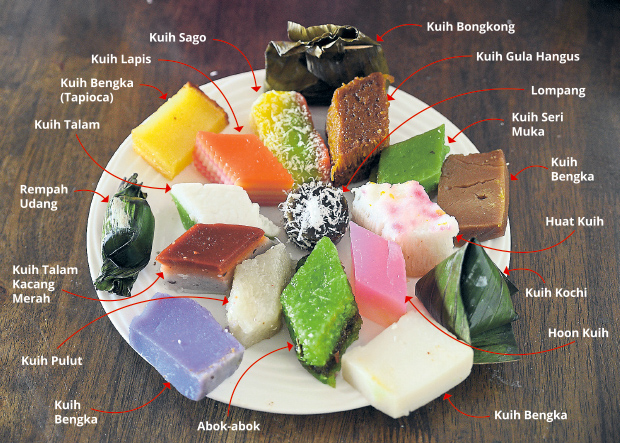
Chapter 27
On the mat between us is a tray filled with various types of kuih. The ketua picks up the tall jug of chilled rose syrup and pours it out into glasses that he hands to us.
Eee all the kuih! From: https://www.malaymail.com/news/eat-drink/2016/03/27/malaysian-kuih-a-marriage-of-flavours-and-cultures/1087719

###

That's it for today!

Head back to my theme reveal and master list.

Go check out the other A to Z Bloggers!


###

The Tale of the Hostage Prince (Book 1.5) – Releases 14 April 2022

Yosua wears an uneasy crown. Although he is now Raja of Bayangan, he still longs for the land of his birth where everything was much simpler…and less deadly.

But peace doesn’t come easily, not for a twenty-year-old servant playacting at being king.

With his parents brutally murdered and his uncle bent on revenge, Yosua must decide where his loyalties truly lie. With his only remaining relative and the kingdom he has claimed? Or with his best friend Mikal and the sultanate that raised him as a hostage?

PREORDER NOW!

International purchases books2read.com/HostagePrince

Wednesday, 6 April 2022

#AtoZChallenge: E for Emigration and Exile

What does it mean to leave your country and head to somewhere new?

I think this question is one that many people are grappling with worldwide, whether they are considering emigrating for a better future, or whether they are being forced to flee their own country due to circumstances beyond their control.

I’ve left Penang and Malaysia for short periods of time, but never for good. It was always with the intention to return. But that doesn’t stop me from asking what if? What if, in 2015, I had decided to relocate to San Jose, California instead of travelling there every half a year for work? What if, in 2019, after finishing my Masters, I decided I liked London so much that I found a way to stay?

Besides, one of the questions ethnic Chinese and Indians face in Malaysia every so often is the question, Why don’t you leave?

My dedication for The Tale of the Hostage Prince reads:

For the diaspora,
third-culture kids,
and the pendatang who know no other homeland.

It’s funny (in the ouch-how-dare-you, not the haha kind) that third- and fourth-generation Chinese in Malaysia are still called “pendatang” (immigrants) and often told to “go home”. Even more awkward when the Baba Nyonya or Peranakan Chinese community get lumped into that, when their families have been rooted in Malaysia for centuries. What “home”, I have to ask? My grandparents were born in Malaysia. China is not my home.

Question: If a Chinese-Malaysian emigrates, are they the Malaysian diaspora or do they revert to being Chinese diaspora even if they have never set foot in China?

This kind of cultural and ethnic identity is one that Yosua grapples with in Hostage Prince. His parents were Bayangan, brought to Maha as captives. He was born in Maha, grew up in Maha, has “assimilated” because that’s all he’s ever known. And now he’s back in his “homeland”, the one he’s tied to by blood. And heritage.

But who is he really?


In Amok, Yosua made a decision to stay in Bayangan, to finalise his emigration, even though he knew the political situation would make it akin to exile.

Now he has to come to terms with it.

###

That's it for today!

Head back to my theme reveal and master list.

Go check out the other A to Z Bloggers!


###

The Tale of the Hostage Prince (Book 1.5) – Releases 14 April 2022

Yosua wears an uneasy crown. Although he is now Raja of Bayangan, he still longs for the land of his birth where everything was much simpler…and less deadly.

But peace doesn’t come easily, not for a twenty-year-old servant playacting at being king.

With his parents brutally murdered and his uncle bent on revenge, Yosua must decide where his loyalties truly lie. With his only remaining relative and the kingdom he has claimed? Or with his best friend Mikal and the sultanate that raised him as a hostage?


PREORDER NOW!

International purchases books2read.com/HostagePrince

Tuesday, 5 April 2022

#AtoZChallenge: D for Developing The Tale of the #HostagePrince

One question every writer seems to get (or at least I do) is how did you develop your story? Did you write an outline first? Do you plan out your character arcs? Determine the beats of the story? Or do you just write and create on the spot?

Or, as common parlance puts it: are you a plotter or a pantser? If you don’t know what this means, here’s a great article: https://thewritepractice.com/plotters-pantsers/. Other terms include “architect vs gardener” or “outlining vs discovery writing”.

I’m…pretty much a pantser. I find it very, very difficult to sit down and work out an outline from scratch. I’ve tried. And failed. Many, many times. What tends to work for me is to start writing first, let the story grow in multiple directions, if necessary, until I hit a spot where I go, “There—there’s the story.” From that point, I can either finish up the story so that I know how it ends, or I can go backwards into writing a semi-coherent plot and outline, then work on rewriting the whole thing.

What now is The Tale of the Hostage Prince has a convoluted history. Actually, the development whole series is very convoluted. See, I wrote Absolution first—or what I used to call The Weight of Sin. And then I figured it needed a prequel to explain why Terang got to where it was. So I thought, why not make it a trilogy! Fantasy series are usually trilogies, no?

So I started planning it out:
  1. The Weight of Strength
  2. The Weight of Secrets
  3. The Weight of Sin
Sounded like a good plan. I'd already gotten the third one. The first one was easy. It definitely had to do with Maha, and how Terang fell from grace in the first place. That slowly evolved into Amok, which also draws inspiration from the biblical tale of Samson and Delilah, because, magical strength, y’know?

But The Weight of Secrets had me stumped. I thought I’d go with something to do in Impian, which has Justices that have the gift of Mind-reading. Even the head of the Justices is called the Secretkeeper! So I was playing around with various ideas surrounding Nek Ramalan (the Secretkeeper in Amok) and her daughter Rahsia. Then I thought maybe the story would be about Iman, Rahsia’s best friend, who shockingly inherits Nek’s powers (You can read Shattered Memories, a short story about this, in The Painted Hall Collection—though it’s a little outdated by now; Rahsia’s journey and many worldbuilding details have evolved since writing that in 2018). But nothing really stuck.

So I thought okay, fine. I can work with a duology. That’s not uncommon.

But by the time I was finishing Amok, Yosua had grown to be so much more than just the sidekick—I’d initially planned a dual POV between Mikal and Yosua for Amok before I switched over to Mikal’s POV exclusively. Yosua…deserved his own story. And I kind of wanted to know what he’d do after the events of Amok. Would he stay in Bayangan? And if yes, why?

Thus, The Weight of Secrets became Yosua's story, The Tale of the Hostage Prince.

More about that in H for Hostage and Y for Yosua!


###

For those still wondering how pantsers work with story, structure, here’s a good article on that: https://www.advancedfictionwriting.com/blog/2017/11/10/seat-of-the-pants-story-structure/ 


###

That's it for today!

Head back to my theme reveal and master list.

Go check out the other A to Z Bloggers!


###


The Tale of the Hostage Prince (Book 1.5)

Yosua wears an uneasy crown. Although he is now Raja of Bayangan, he still longs for the land of his birth where everything was much simpler…and less deadly.

But peace doesn’t come easily, not for a twenty-year-old servant playacting at being king.

With his parents brutally murdered and his uncle bent on revenge, Yosua must decide where his loyalties truly lie. With his only remaining relative and the kingdom he has claimed? Or with his best friend Mikal and the sultanate that raised him as a hostage?


PREORDER NOW!

International purchases books2read.com/HostagePrince

Monday, 4 April 2022

#AtoZChallenge: C for Cast of Characters

Some SFF books have a cast of characters, either at the front or end of the book. I mooted the idea for a while but it was a little too difficult to compile, and I didn’t know what information to include. At any rate, I do have a working draft from the last attempt, so I updated it a little for this post! 

For simplicity, I think I’ll only include the major/important characters so that it doesn’t get too long and confusing.

The ones marked (*) were in Amok but are not in The Tale of the Hostage Prince, though they may be alluded to.


Bayangan 

Yosua ayell Garett, also known as Yosett Regis Baya: The current Raja of Bayangan (and the current viewpoint character! He grew up as a servant to Mikal in the Mahan Palace.

Garett Regis Baya: Yosua’s father, formerly the Raja Muda of Bayangan before he was taken captive by Simson.

Marla Ishi: Yosua’s mother. The Ishis are a prominent noble family in Bayangan and she grew up in the Bayangan Castle before she was taken captive by Simson. 

Jeffett Ishi: Marla’s eldest brother. He became Regent of Bayangan after Garett was taken, and raised Layla to take the throne. 

Layla Regis Ishi*: Garett’s youngest sister. Raised by Jeffett, she eventually took his name (Ishi) along with the Regis indicator of the ruling family when she assumed the throne.

Carla Tuah: One of the oldest and most influential nobles on the Majlis DiRaja. The Tuahs are a prominent noble family in Bayangan.

Azman Tuah: Yosua’s close friend in Bayangan, and Carla’s grandnephew. He’s been marked to take Carla’s place on the Majlis.

Relka: Yosua’s servant.


Terang

Terang is made up of three city-states, so I'll just divide the cast by those as well. 

Maha

Simson*: Previous Sultan of Terang & Maha. He defeated Bayangan 20 years before the events of Amok and took the firstborn children as captives to Maha.

Mikal: Current Sultan of Terang & Maha, Simson’s only son. 

Yaakub*: Temenggung of Maha, he was Mikal’s mentor.

Rizal: Laksamana of Maha, he is the only one of Simson’s Majlis Maha to survive the events in Amok, and is currently still holding the post. 

Daud: Head of the Temple in Maha.

Han: One of the Tawanan, he grew up in the Mahan Palace with Yosua. Now, he leads troupes between Maha and Terang, often acting as messenger between Yosua and Mikal.


Suci

Ikhlas*: Uskup Agung of Terang, and the head of the Temple in Suci

Farouk: An Uskup from Suci, one of the forerunners to succeed Ikhlas as Uskup Agung. 


Impian

Nadir: Titular head of Impian

Ramalan*: Previous Secretkeeper of Terang. Besides having the Mind-reading Gift of the Justices, she also sees visions of the future. 

Rahsia: Ramalan’s granddaughter. She is a Justice, and was sent as a spy to Bayangan in Amok.


###

That's it for today!

Head back to my theme reveal and master list.

Go check out the other A to Z Bloggers!


###

The Tale of the Hostage Prince (Book 1.5) – Releases 14 April 2022

Yosua wears an uneasy crown. Although he is now Raja of Bayangan, he still longs for the land of his birth where everything was much simpler…and less deadly.

But peace doesn’t come easily, not for a twenty-year-old servant playacting at being king.

With his parents brutally murdered and his uncle bent on revenge, Yosua must decide where his loyalties truly lie. With his only remaining relative and the kingdom he has claimed? Or with his best friend Mikal and the sultanate that raised him as a hostage?


PREORDER NOW!

International purchases: books2read.com/HostagePrince
Malaysia: Teaspoon Publishing

Saturday, 2 April 2022

#AtoZChallenge: B for Bayangan

 The Tale of the Hostage Prince is mostly set in a kingdom called Bayangan. It’s ruled by a Raja, who is elected by a council of nobles called the Majlis DiRaja (literally, council of kings, but oh well). This may or may not be influenced by the way the Yang di-Pertuan Agong is, uh, selected in Malaysia but, you know, with a lifetime appointment and other complications. (Wikipedia also tells me Negeri Sembilan practices something of the sort. Maybe S will be for Succession rules, but we’ll see.)

At the back of my books, I give a short blurb on the main places that appear in the Absolution Series. Here’s what you’ll find:

Bayangan is located across the Mahan straits and is said to have been formed by rebels who seceded from the Terang Sultanate due to differences in beliefs. The rulers of Bayangan have maintained its animosity and enmity over the years, leading to frequent wars between the two kingdoms.

That sounds pretty dry, so here’s a little excerpt that covers Bayangan’s founding legend, how it got its name in the story world*, and the Regent’s Festival! 

To set the scene: It’s the Regent’s Festival in Bayangan, and Yosua is griping (a little) about his duties as king. (Note: the novel is in Yosua's point of view!)


Chapter 3 Excerpt

In keeping with tradition, I’m required to hold the Regent’s Court in the throne room, listening to the gripes of the people and settling them as the ultimate judge over Bayangan. They’re only supposed to escalate the most difficult cases to me—the ones that have been disputed too many times, those which the magistrates cannot handle, those which need a tougher sentencing that only the Raja is allowed to pronounce. Yet most of them are petty squabbles, easily dealt with. I suspect they delay their cases on purpose in hopes that their hearing would fall during the festival—who doesn’t want to say that the Raja himself judged their case at the Regent’s Court? Twenty years ago, when the population of Bayangan was decimated, and the kingdom was in disarray, I can imagine this was a useful tool for my uncle to consolidate power and support, and to prove his ability to rule. But now? Now it is nothing but a useless spectacle. 

It’s tough to listen to their long grandfather’s stories without tapping my feet or drumming my fingers on the nearest surface. I would rather even be at parang training, being humiliated by the weapons master, than this. I plaster an attentive look on my face that I can only hope looks genuine. Beside me, Azman sniggers. 

‘Shut up,’ I scold with my fingers though, of course, he doesn’t understand.  

Various performers congregate in the courtyard, entertaining those waiting for their turn to tour the castle with songs and stories and sleight of hand. Han and his troupe perform in the dining room all day, presenting a stunning repertoire of stories collected from the farthest reaches of Bayangan. 

I don’t get to watch until the evening, stuck as I am with my duties. With the crowd ebbing and flowing throughout the day, there’s no formal protocol. Everyone fills their plates from the loaded buffet table whenever they’re hungry and finds a place to sit. 

I’m almost done with my dinner when Uncle Jeffett sits down beside me with a heavy thud. His face is unexpectedly grim for an event like this. Straight ahead, the evening performance starts and his expression darkens.

“And so it goes,” Han calls.

The chorus responds, “If you will listen, O Raja.”

Han echoes, “If you will listen, O Raja.” 

“This is how it went,” the chorus replies.

“In the year of the locust, when magic corrupted Terang, there stood a man head and shoulders above the others, who was not afraid to fight alone.”

They launch into a swashbuckling story of the founding of Bayangan, from when Harett Baya rejected the cult of Terang and founded his own kingdom. There are fantastic sea battles up and down the straits accompanied by dramatic declarations, until Harett finally convinces Sultan Yosua to leave them alone. Harett Baya names his newly formed kingdom Bayangan, after himself, and adds Regis to his surname. His descendants—and many nobles who aspire to kingship—tag the ‘ett’ suffix to their names in honour of him. It’s a beloved story, but not one that I would have preferred the rapt audience to be reminded of right now. 

The legend they tell here is vastly different from the version I grew up with, where my namesake performed a penance and wept over the people living under the shadow of fear and ignorance. I know that version like the back of my hand, its forms engraved into my body’s memory. I dance it in my mind’s eye, tracing Kudus and faith into the palm of my hand, as Han’s troupe plays out the Bayangan version in front of me. 

I try to look beyond the surface of this performance to see what Han is saying in private, but again, there are no hidden messages—at least, not for me. Did someone request this story—someone opposed to the new policies I’m trying to push—or did Han choose it of his own volition? And if the latter, to what end? 


###

* I made up this legend after the fact. The real story is that I was being very, very literal in my naming. Since Terang = Bright/clear, their enemy obviously had to be Bayangan = Shadow/shade. I’m sorry. Lol.


###

The Tale of the Hostage Prince is now on NetGalley, so if you have an account there, click the widget thing below to get an ARC! 


###

That's it for today! 

Go check out the other A to Z Bloggers!

Friday, 1 April 2022

#AtoZChallenge: A for Absolution

Welcome to the A to Z Challenge! Today's post is A for Absolution.

The Absolution Series is a duology consisting of Amok (released June 2021) and Absolution (coming this November!) But wait, you ask, there are three titles in that picture!

While Amok and Absolution revolve around the fall and restoration of Terang (therefore are books #1 and #2 respectively), The Tale of the Hostage Prince is a side story that follows what happens to Yosua in Bayangan after the events of Amok. Since it isn’t directly related to the main story arc of the other two, I made it #1.5.

(Confusing? Yeah, I know. Maybe this wasn't a good idea. lol)

Here are the book descriptions & buy links!

###

The Absolution Duology

Amok (Absolution #1) – June 2021

What is faith, except hope in desperation?

All Putera Mikal wants is to gain the Amok Strength, the supernatural power granted by Kudus to the royal family. Yet no matter how religiously he keeps his vows, Kudus denies him the Strength—even while his father, Sultan Simson, blatantly defies the Temple, insisting on a marriage alliance with the enemy queen despite the priests’ visions of doom.

Then the prophecies come true.


International purchases: books2read.com/Amok

###

Absolution (Absolution #2) – Releasing November 2022

If cursed is the hand that kills, then it wouldn't matter if that same hand stole, would it?

Tulen feels doubly cursed, forced to serve the bratty princess of Impian as punishment for her crimes, until said princess embarks on a pilgrimage. Tulen grabs her only chance to offer a sacrifice at the holy city of Suci—and maybe, finally, feel clean again.

Sultan Mikal has set his face towards Suci—and certain death. Nothing about his Penance is clear, except the fact that if he fails, Terang will fall along with him.

When Tulen’s pilgrimage intersects with Sultan Mikal’s quest to fulfil the Covenant of Salt, Tulen faces a difficult dilemma: What is her absolution worth in the face of the sultanate’s very existence?

###

The Tale of the Hostage Prince (Book 1.5) – Releases 14 April 2022

Yosua wears an uneasy crown. Although he is now Raja of Bayangan, he still longs for the land of his birth where everything was much simpler…and less deadly.

But peace doesn’t come easily, not for a twenty-year-old servant playacting at being king.

With his parents brutally murdered and his uncle bent on revenge, Yosua must decide where his loyalties truly lie. With his only remaining relative and the kingdom he has claimed? Or with his best friend Mikal and the sultanate that raised him as a hostage?


PREORDER NOW!

International purchases: books2read.com/HostagePrince

###

That's all for today. See you tomorrow for B for Bayangan! 

Go check out the other A to Z Bloggers!